AddiWire

Additive manufacturing news and European prices, with independent expert commentary

Industrial AM

SLS wall thickness: why a printable wall is not yet a production wall

Published 1 sourceSummary written with AIDeutsche Version
SLS wall thickness: why a printable wall is not yet a production wall
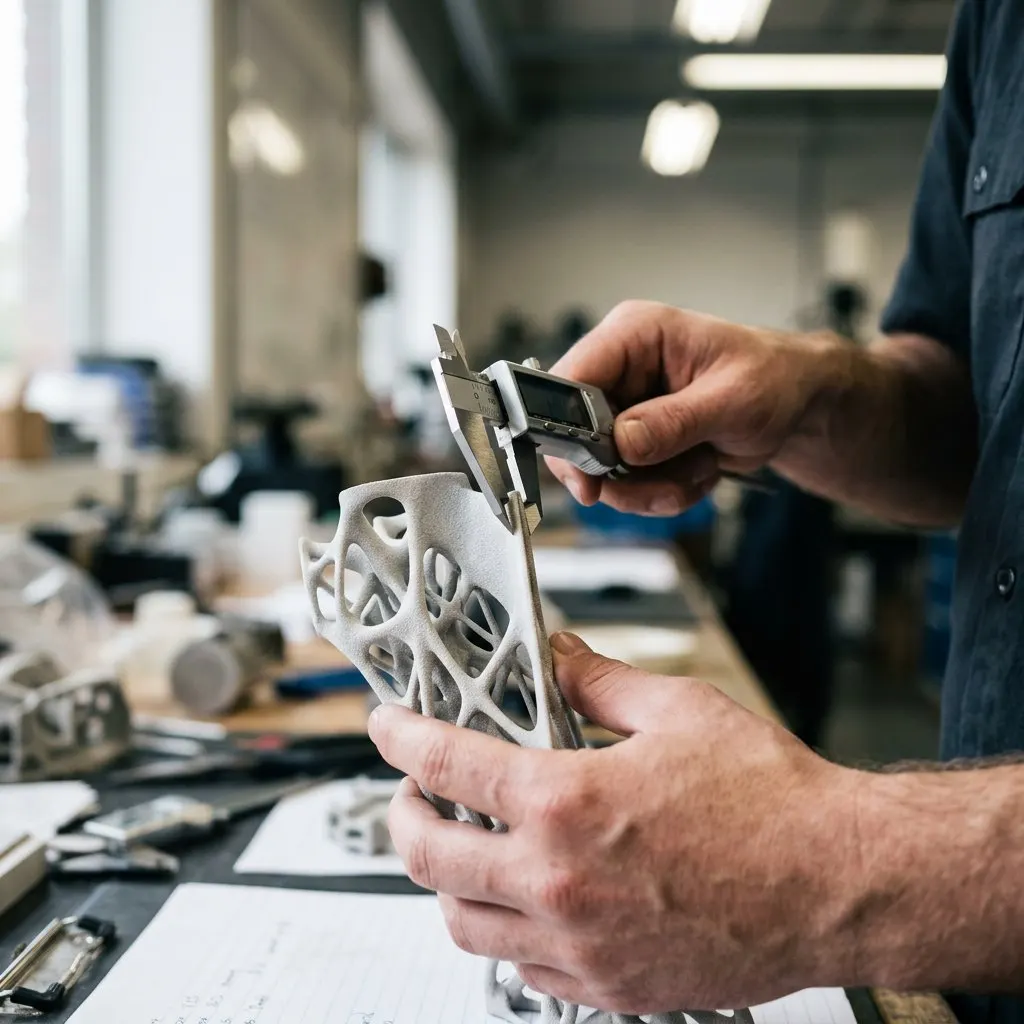
Image: Inframotion 3D

Inframotion 3D has published a guide to minimum wall thickness in selective laser sintering. It puts roughly 1.0 mm as a first checkpoint for polymer parts, but stresses that the thinnest wall that once printed is not the same as a wall that survives repeated production, cleaning and use.

Key facts
  • Around 1.0 mm is cited as a first checkpoint for general SLS walls
  • Recommended wall and thinnest printable wall are treated as different numbers
  • Tall walls, free edges, sharp corners and filled powders raise the safe thickness
  • Thin exceptions should be proven on the intended material and printer

Context Depowdering is the removal of loose, unfused powder from a part after an SLS build, usually with compressed air, brushes or blasting.

Recommended wall versus absolute limit

The guide separates two numbers that engineers often merge. One is a design recommendation, a wall target chosen for dependable repeat builds and a usable part. The other is the thinnest feature that might survive a single favourable build. Designing at that edge adds risk at every later step, from cooling to cleaning, finishing and assembly. For polymer SLS, about 1.0 mm is named as a typical first checkpoint for general walls in forgiving geometry, not a universal pass-fail value.

Why SLS tolerates thin geometry, and where it still fails

Because unfused powder carries the part during the build, SLS needs no separate supports and can make channels, enclosed features and lattice-like sections. That helps thin walls, but does not remove the risk. Tall, slim walls can curl or buckle as they cool in the powder cake, and long free edges have little restraint. Edges near corners and openings can also be too fragile for cleaning. The guide adds that wall thickness is a different matter from feature resolution or text legibility.

What raises the safe thickness

Several factors push the sensible target above the headline figure: a high wall relative to its thickness, long unsupported spans, sharp corners and cutouts, abrupt thickness changes, stiffer filled powders, and functional features such as threads, inserts, sealing faces and snap regions. Later sanding, coating, dyeing or machining also eats into the margin, so the guide advises designing for the finished part rather than the as-printed minimum.

When thinner walls can work, and how to validate

Short ribs tied into a thicker body, walls anchored at both ends, cross-braced or corrugated forms, and compact, rounded housings can succeed below the usual target. Tall fins, lightly restrained curved shells and covers around large openings are riskier. Any such exception should be confirmed on the intended material and printer, and the guide recommends checking local minima in CAD, for example around openings and junctions. It also warns against copying wall rules from SLA, MJF or injection moulding.

What it means

For small and mid sized manufacturers, the practical lesson is that a sample part proves little about yield. A wall chosen at the printable edge can raise scrap, cleaning damage and rework, which pushes up cost per part once volumes grow. Wall rules from other processes should not be carried over, and any thin exception needs its own test on the intended powder and machine before release. Teams without in-house AM experience can use such checkpoints to brief a service bureau, but final values still come from the supplier's own process.

Earlier on AddiWire

Frequently asked questions

What is a typical minimum wall thickness for SLS?

The guide names about 1.0 mm as a common starting point for general walls in forgiving geometry, and says it is not a universal safe value for every part, powder or printer.

Why is the thinnest printable wall not a good design target?

A wall that forms once may still distort, break during cleaning or fail under handling, so it does not guarantee repeatable production.

Can SLS walls be thinner than the headline value?

Yes, for short ribs, anchored sections, braced forms or compact rounded housings, but each case should be confirmed on the intended material and printer.

Read the original reports
  1. Inframotion 3D, 1 Nov 2026