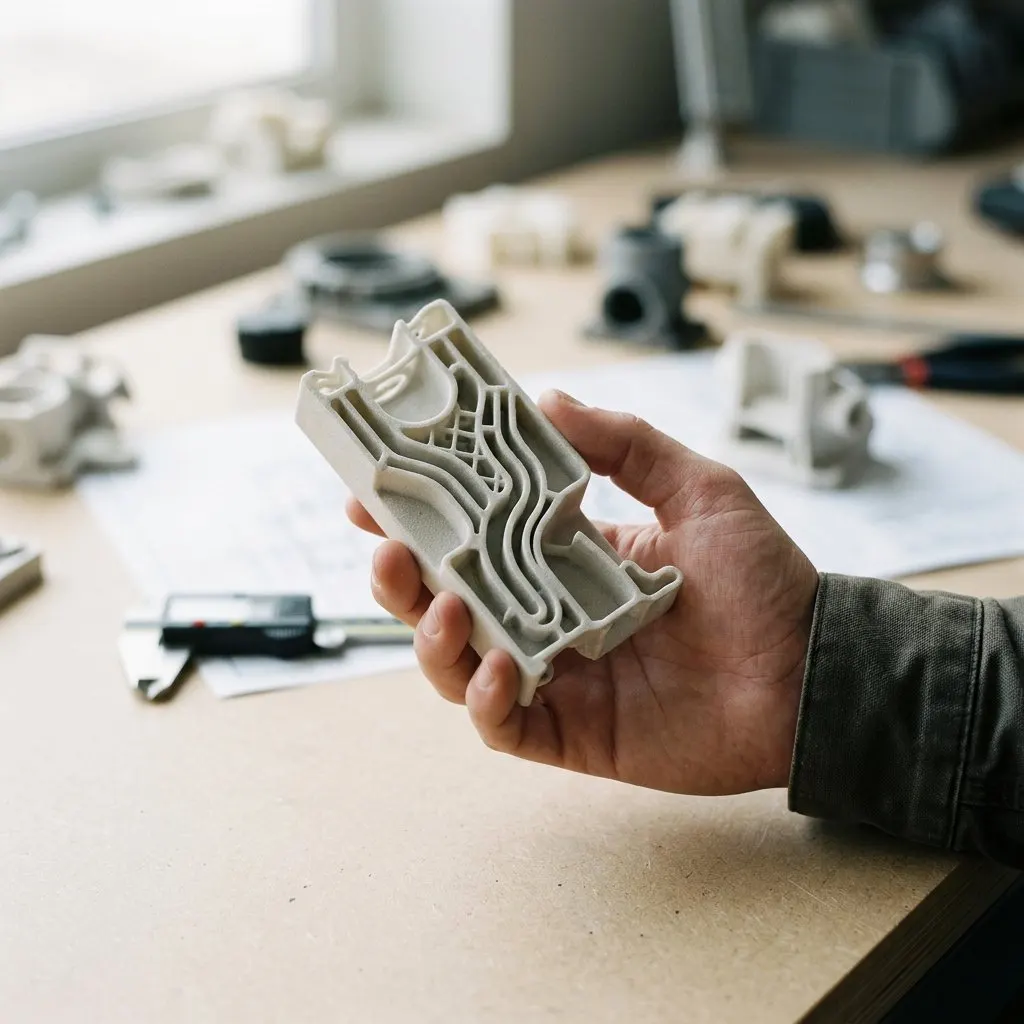
Why SLS allows freer geometry
The surrounding powder bed carries the part during the build, so no support structures are needed. Enclosed channels, lattices, undercuts and nested assemblies are therefore realistic options, and the process suits functional parts as well as prototypes. Heat shrinkage, powder packing and laser energy still influence accuracy, surface quality and warping, and the safe design window shifts between PA12, PA11, glass-filled nylon and TPU.
Orientation, warping and tolerances
Orientation determines strength direction, surface appearance, dimensional stability and which faces hold critical fits. Large flat areas and long thin spans tend to distort. Tilting the part, interrupting flat faces, adding ribs or lattice reinforcement, or splitting oversized parts can lower that risk. The guide cites an early planning figure of about plus or minus 0.3 mm, or 0.3 percent of nominal length, but calls it guidance only. Holes and mating features need allowance, reaming or machining suits tight bores, and critical assemblies should be checked with coupons or a first article.
Lowering build cost
Grouping similar parts and choosing orientations that use the chamber well helps throughput. Hollowing, shelling or lattices cut weight and powder use, provided the part still empties cleanly. Cosmetic finish demands and extra machining add cost without function. Designs that depowder consistently also support better powder refresh and reuse economics.