Which five signals justify a closer look?
The guide lists recurring demand, frequent design changes, a stable range of materials and geometries, named ownership of the printer and process, and a measurable operational benefit. For demand, it advises separating committed orders from possible future uses and estimating machine hours, since a few long builds can fill a lot of capacity. For design changes, the whole iteration cycle should be measured, from design to evaluation.
How should the cost comparison be built?
Start with the external cost of parts delivered in the required condition, including finishing, inspection and transport. Compare it with internal production at the same acceptance level, counting equipment, installation, training, maintenance, labour, consumables, post-processing, inspection, failed builds and rework. The simplified break-even quantity is annual incremental fixed cost divided by the difference between outsourced cost and internal variable cost per accepted part. It holds only if that difference is positive and capacity suffices. Cash payback should be kept separate.
What about service providers and hybrid models?
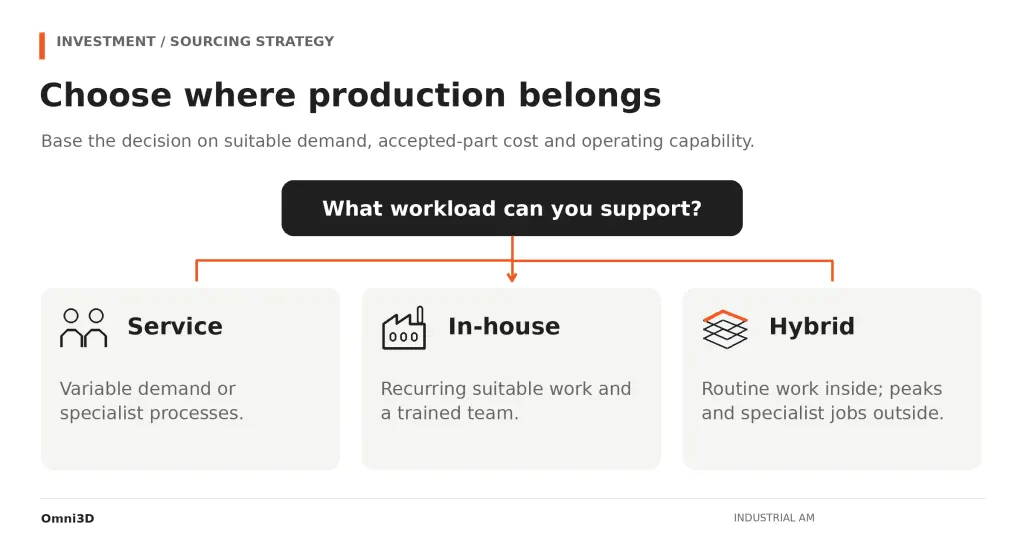
Service providers are described as a sensible starting point for testing materials, validating designs and learning finishing needs. A hybrid model can keep routine tooling inside while special materials, extra capacity or some metal jobs stay external. For metal LPBF, planning must also cover powder handling, facility needs, post-processing and inspection, with polymer and metal costed separately.