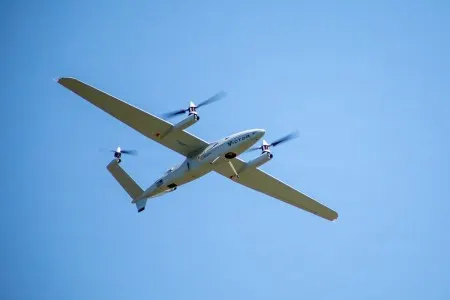
The US Army research laboratory DEVCOM ARL has flown a hybrid propulsion unit whose heavy-fuel rotary engine was made with metal 3D printing. The engine drives a generator that feeds an electric system, and it flew in the VICTOR drone, a Group 3 unmanned aircraft built with Griffon Aerospace. The Army calls it the first 3D printed heavy-fuel engine; results now pass to industry partners and to the planned PULSAR drone concept.
Key facts
Engine: heavy-fuel rotary design, made with metal 3D printing, air-cooled
Paired with a new 400-volt motor-generator in a series hybrid
Flown in VICTOR, a Group 3 drone built with Griffon Aerospace
Program involved 30+ universities, 13+ federal labs, 20+ industry partners
Context A heavy-fuel engine runs on kerosene-type fuels such as JP-8 rather than petrol, which simplifies military logistics; a series hybrid uses the engine only to generate electricity for the electric drive.
The headline says printed engine, but one of the reports calls it only partly made additively, and none says which parts. For a European engine or drone supplier, that distinction matters most. Printing used to shorten design loops is a development tool. Printing that stays in flying hardware is a qualification commitment, with military airworthiness rules attached. In an air-cooled rotary engine, the housings take repeated thermal cycling, and in my experience fatigue on as-built surfaces is where printed metal parts often fall short of datasheet values. Before treating this as a template, I would ask which components stay printed in the design meant for series, in which alloy and heat treatment condition, and with what fatigue evidence. Until the design stops changing, buying fast iterations from a qualified metal service provider usually makes more sense than buying a machine.
DEVCOM ARL combined a rotary engine made partly by metal 3D printing with a new 400-volt motor-generator. In this series-hybrid layout the engine produces electric power rather than driving the propeller directly. The unit was flown in VICTOR, a mid-sized vertical takeoff and landing drone built around it with industry partners including Griffon Aerospace. Flights took place near Huntsville, Alabama. The Army describes the engine as the first 3D printed heavy-fuel engine.
How did additive manufacturing help the design?
ARL started from a clean sheet and used computational fluid dynamics to improve how fuel atomises and vaporises in a rotary engine, while cutting leaks of compressed air and fuel vapour. According to program manager Chol-Bum Kweon, metal printing let the team redesign engine components quickly after each round of experiments. It also made an air-cooled design possible, which shrinks the propulsion system and removes the need for liquid coolant.
What comes next?
The work ran under the Versatile Tactical Power and Propulsion research program, involving more than 30 universities, over 13 federal laboratories and more than 20 industry partners. It yielded hundreds of journal papers plus patents and patent applications. Findings now go to industry partners for maturation. They also feed PULSAR, a concept for multi-mission swarms of VICTOR drones. Both VICTOR and PULSAR are to be made available to military partners for experimentation, while industry keeps refining VICTOR for other uses.
What it means
For manufacturers, this is a research demonstration, not a qualified production route, and the reports give no data on printed materials, machines, part counts or durability. The useful signal is the workflow: simulation-led redesign with fast print iterations, which shortens development cycles for thermally and fluidically demanding parts. Suppliers in defence and aerospace should expect propulsion work to move to industry partners next, but certification and cost per engine remain open questions.
Frequently asked questions
What is new about the VICTOR engine?
The Army describes it as the first 3D printed heavy-fuel engine, a rotary design paired with a 400-volt motor-generator in a series hybrid.
Why is the engine air-cooled?
According to ARL, metal printing allowed a redesign into an air-cooled engine, which reduces propulsion-system size and removes the need for liquid coolant.
Is the engine in production?
No. It is a research result handed to industry partners for maturation; VICTOR and PULSAR are to be offered to military partners for experimentation.