AddiWire

Additive manufacturing news and European prices, with independent expert commentary

Materials

CR-3D adds PPS CF10, a flame-retardant carbon filament rated to 250 °C

Published 1 sourceSummary written with AIDeutsche Version
CR-3D adds PPS CF10, a flame-retardant carbon filament rated to 250 °C
Image: CR-3D

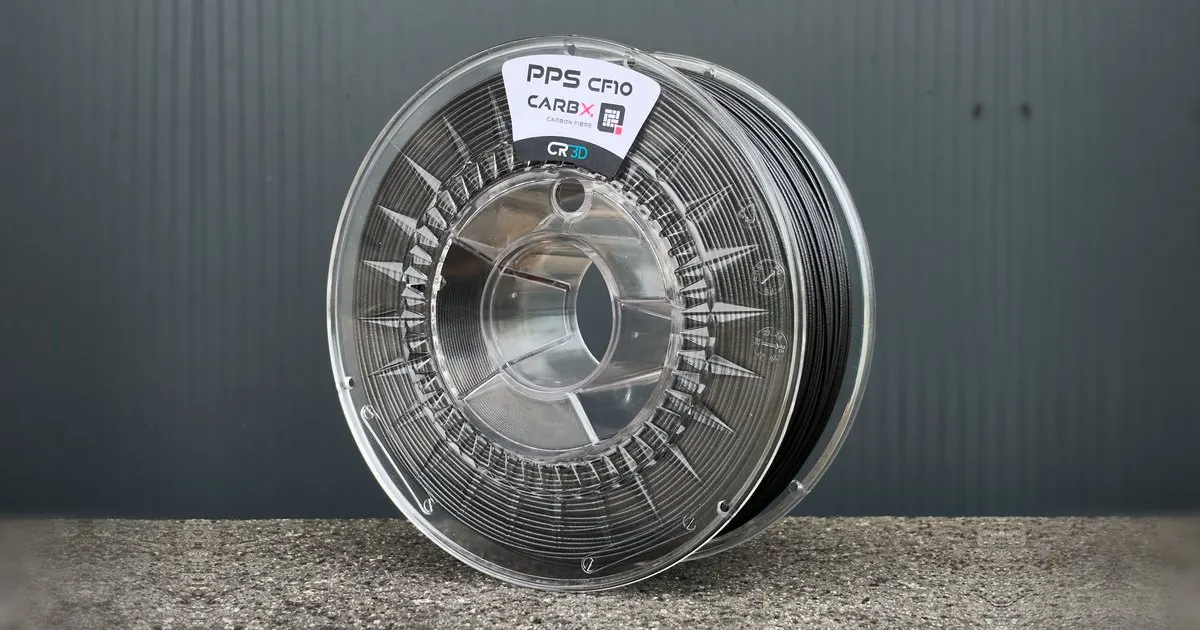
CR-3D has presented PPS CF10, a polyphenylene sulfide filament with 10% carbon fibre. It stays dimensionally stable to 250 °C under ISO 75, meets UL 94 V-0 and resists many chemicals. It is the fourth and last material in the company's FlameX line and also belongs to the CarbX line.

Key facts
  • Heat deflection 250 °C under ISO 75, highest in CR-3D's range
  • Rated UL 94 V-0 with 10% carbon fibre
  • Tensile modulus 8,000 MPa, tensile strength 100 MPa
  • Nozzle 300 °C, hardened 0.6 mm or larger, closed chamber

Context UL 94 V-0 is the highest class of the vertical burn test for plastics, and ISO 75 measures the temperature at which a loaded plastic sample deforms under a defined bending load.

What is PPS CF10?

PPS CF10 is built on polyphenylene sulfide, a plastic for high temperatures, with 10% carbon fibre for stiffness and dimensional accuracy. The figure in the name states the fibre share. CR-3D lists a tensile modulus of 8,000 MPa and a tensile strength of 100 MPa. It belongs to both the FlameX line (flame-retardant) and the CarbX line (carbon fibre reinforced), and it completes the four-material FlameX series.

How does it compare with other materials in the range?

At 250 °C under ISO 75, PPS CF10 has the highest heat resistance of CR-3D's materials. The comparison lists PET CF15 and PA12 CF15 at 150 °C and PC-ABS at 122 °C, though these are given as service temperatures rather than ISO 75 values. PET CF15 is stiffer at 9,100 MPa, while PPS CF10 adds flame retardancy and higher strength but needs a hotter nozzle. For chemicals, CR-3D gives a guideline for the PPS material group: very good resistance to water, salt solution, mild acids, antifreeze, alcohols and acetone. For continuous contact it advises testing on the actual part.

How is it processed?

The material needs a hardened nozzle of at least 0.6 mm at 300 °C, the hottest in the FlameX line, and a heated bed at 100 °C with Powder PEI or FR4 plates. The build chamber must be closed. The spool is dried for 12 hours at 90 °C and stored dry. Part cooling is capped at 30%, and the first three layers print without it. It comes in black on 1 kg and 2 kg spools. Intended uses include housings for sensors and actuators, pump and valve components, HVAC holders, fixtures near hot parts and tooling.

What it means

For manufacturers using FDM, a flame-retardant PPS filament extends printing to under-hood and process-heat parts that usually need machined or moulded plastic. The practical cost is the process: a closed hot chamber, a 300 °C nozzle, a hardened nozzle and 12-hour drying. The figures are supplier data and a guideline for the material group, so parts with long chemical contact or safety relevance still need their own testing and qualification. This follows CR-3D's earlier overview of its four UL 94 V-0 FlameX filaments.

Frequently asked questions

What is PPS CF10?

It is a polyphenylene sulfide filament from CR-3D with 10% carbon fibre. It meets UL 94 V-0 and is heat deflection stable to 250 °C under ISO 75.

What printer setup does PPS CF10 need?

A hardened nozzle of 0.6 mm or more at 300 °C, a 100 °C bed with Powder PEI or FR4, and a closed chamber. The spool is dried for 12 hours at 90 °C beforehand.

How does it differ from PET CF15?

PET CF15 is stiffer at 9,100 MPa but is rated to 150 °C. PPS CF10 resists heat to 250 °C, is stronger and flame-retardant, but needs a hotter nozzle.

Read the original reports
  1. CR-3D, 6 Nov 2026