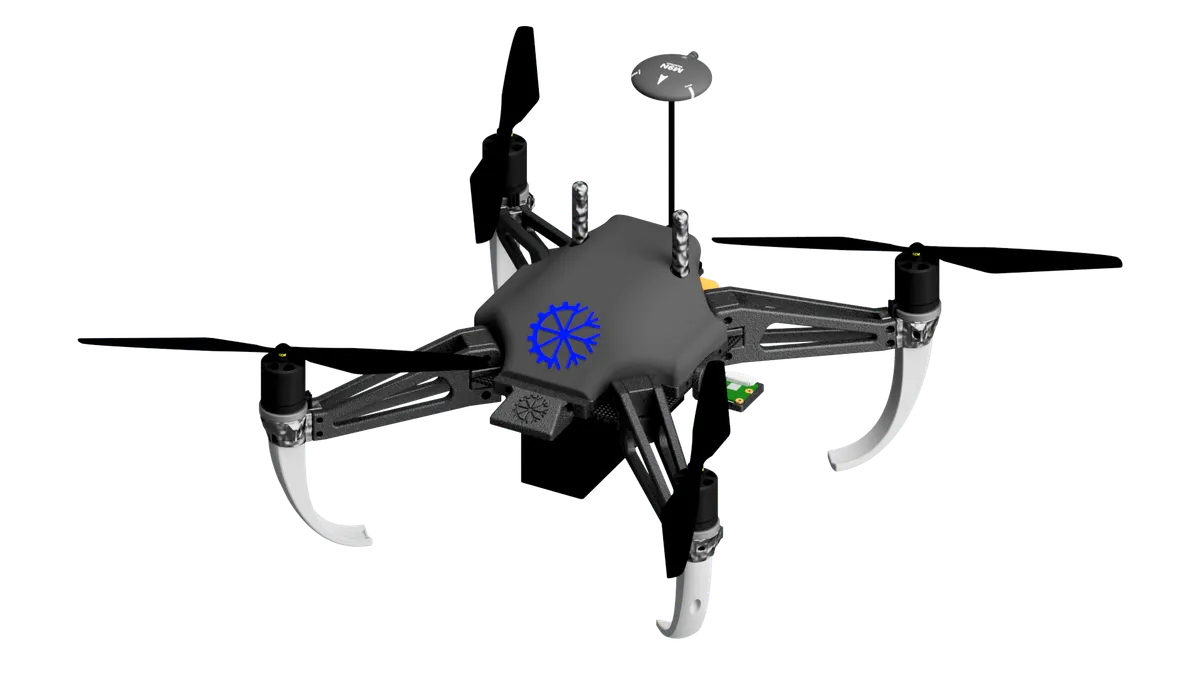
Xenia Materials supplied carbon fibre filled filaments to FRoST, a student team at Frankfurt University of Applied Sciences, for its 1.7 kg DAEDALUS scouting drone. Replacing ASA with XECARB PA11-CF-SL cut part weight by about 31% according to the team's slicer calculations, while a PETG-CF cover gave a cleaner surface.
Key facts
DAEDALUS weighs 1.7 kg and works alongside the rover EROS
PA11-CF-SL parts are about 31% lighter than ASA, per slicer calculation
PA11-CF-SL uses two perimeters and 20% infill versus four and 40% for ASA
PETG-CF cover is 100% recycled PETG with 20% carbon fibre
Context Carbon fiber filled filament has short fibres mixed into the plastic, which is a different thing from continuous fiber fabrication (CFF), where an unbroken fibre strand is laid into the part.
What is the drone and what does it do?
FRoST, the Frankfurt Robotics Science Team, builds robots for the European Rover Challenge, a university contest that simulates planetary exploration with autonomous navigation, sampling and manipulation on Mars-like terrain. Its drone DAEDALUS weighs 1.7 kg and works together with the team's rover EROS, scouting terrain from above and identifying targets.
Which filaments went into which parts?
The motor arms and the spacers that shield the motor mounts from heat use XECARB PA11-CF-SL, a fully bio-based nylon 11 with 15% carbon fibre and a SuperLight weight-reduction technology. The drone cover uses XEGREEN PETG-CF, made from 100% recycled PETG with 20% carbon fibre. The fibre made the layer lines less visible and the finish more even.
How much weight was saved?
The team calculated in its slicer that PA11-CF-SL parts were about 31% lighter than the same parts in standard ASA. Some ASA parts needed four perimeters and 40% infill, while the nylon versions needed two perimeters and 20% infill for the same perceived stiffness. The figure comes from slicer estimates, not from measured tests.
What it means
The 31% figure is a slicer estimate and the stiffness is described as perceived, so it is a direction, not qualification data. Still, the pattern is useful for FFF users: a stiffer material can allow fewer perimeters and lower infill, which cuts weight, material and print time. For small manufacturers, the saving has to be checked on their own load cases and temperatures before any substitution for ASA. The project is also supplier-run promotion through a university programme.