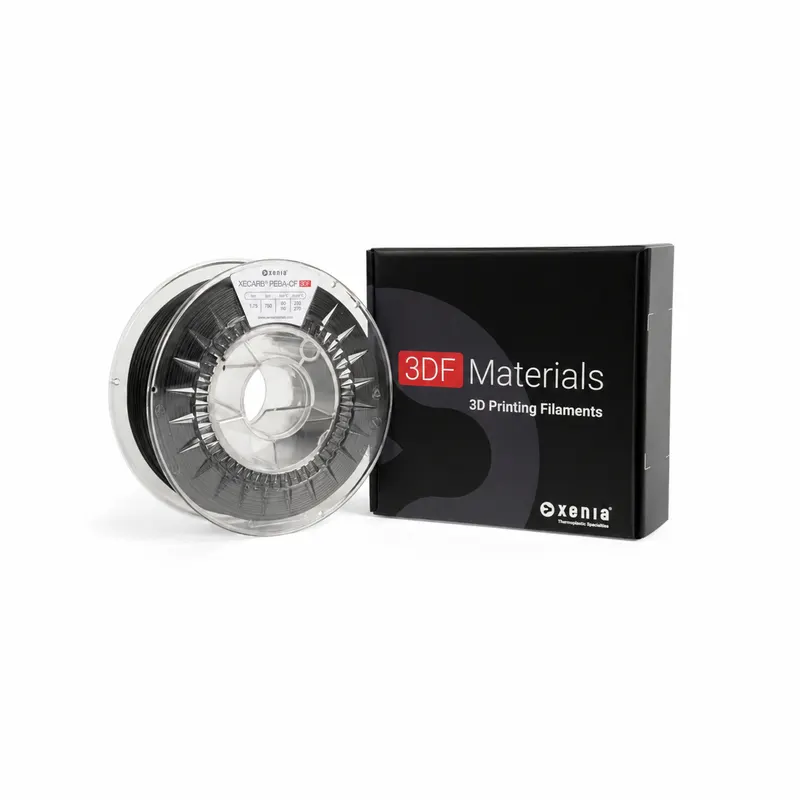
Xenia has announced XECARB PEBA-CF, an FFF/FDM filament based on PEBA and filled with 15% carbon fiber, ahead of Formnext 2026. It targets technical parts that need stiffness, impact resistance, low weight and elastic return. The company names industrial, aerospace, robotics and drone uses.
Key facts
Filament: XECARB PEBA-CF, PEBA with 15% carbon fiber
Density 1.08 g/cm³, HDT 105 °C
Presented ahead of Formnext 2026
Targets industrial, aerospace, robotics and UAV parts
Context PEBA is a thermoplastic elastomer, a flexible polymer that returns energy after deformation, here filled with short carbon fibers.
What are the properties of XECARB PEBA-CF?
The filament combines a PEBA matrix with 15% carbon fiber. Density is 1.08 g/cm³ and heat deflection temperature (HDT) is 105 °C. The fiber adds stiffness, while the elastomeric PEBA gives toughness and returns stored energy after deformation.
Where is it meant to be used?
Xenia lists industrial, aerospace and robotics applications, plus drone and UAV systems, where parts must be light, withstand mechanical stress and respond elastically. The filament joins the 3DF Materials range: PVDF-CF, PA11-CF-SL, PA12-CF-ST, PEBA, PETG-CF and PPA-CF.
What it means
For small and mid sized manufacturers, a carbon filled elastomer filament widens what desktop-class FFF can do for functional parts such as grippers or protective housings. The sources give only density and HDT, no tensile, impact or fatigue data, so any use beyond prototypes needs own testing and qualification. Short fibers also differ from continuous fiber reinforcement in stiffness gains. This continues the earlier AddiWire report on the same filament.