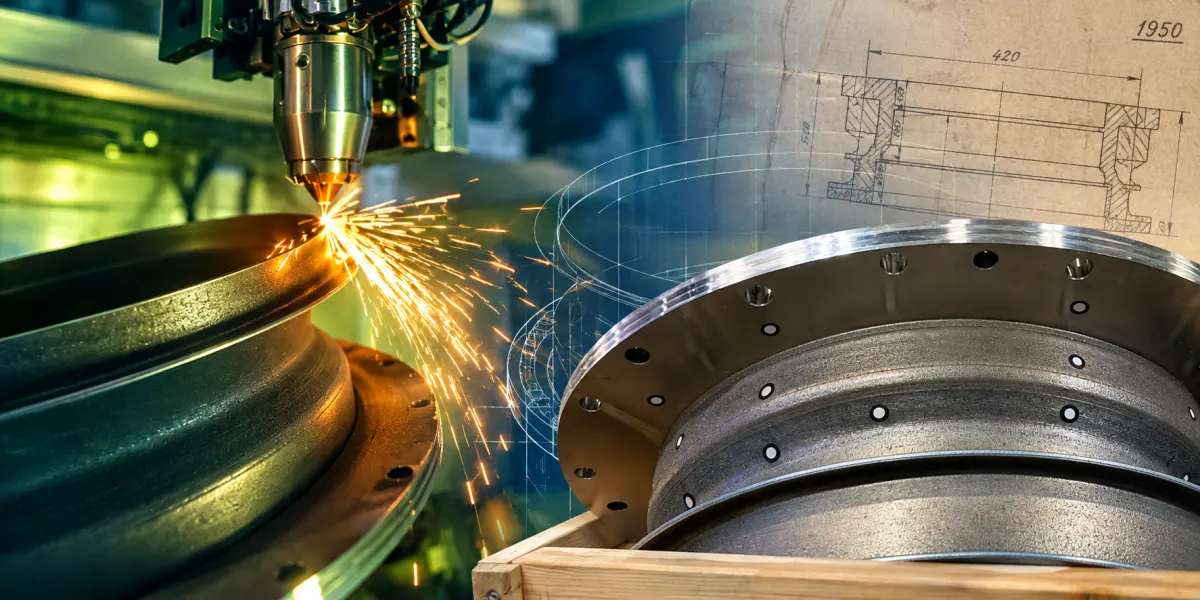
SSAB and RISE have built a replacement oil seal for a rolling mill in Borlänge using directed energy deposition, starting only from a technical drawing dating from the 1950s. The part, about 420 mm in diameter, was made in SSAB's own AM TS2 powder as part of the On Demand 2033 programme. CT analysis is still outstanding before the part is installed, so the spare-part route is not yet proven in service.
Key facts
Reference was a technical drawing from the 1950s, no CAD model existed
Part is about 420 mm in diameter, built in four sub-geometries
Material: SSAB AM TS2 powder, process DED-LB/p
CT analysis at Nikon Metrology still pending before installation
Context Directed energy deposition (DED) feeds metal powder into a laser-generated melt pool and builds the part layer by layer, which suits large components.
Why was a labyrinth seal chosen as a test case?
The part is an oil seal and spare for a rolling mill at SSAB's site in Borlänge. The equipment dates from the 1950s, and large castings for machines of that age mean very long lead times and high costs, if they can be made at all. Within On Demand 2033 the question was whether old component information can be turned into a new spare part by additive manufacturing.
How was the part made?
No CAD model existed, so RISE built a new digital model from SSAB's technical drawing and adapted the design and the manufacturing strategy to additive manufacturing. The process was directed energy deposition with laser and powder, using SSAB's own AM TS2 powder. The seal is about 420 mm in diameter and larger than the nominal build volume of the machine. RISE therefore developed a fixturing and multi-axis strategy and split the geometry into four sub-geometries built in separate steps.
What do the first checks show?
SSAB machined the surfaces that needed finishing and left the others as built. When mounted in a machine, the part showed no runout, and the first analysis of the 3D scan found only small geometric deviations. Dimensional stability matters because the part has to seal oil. X-ray computed tomography at Nikon Metrology in the UK is meant to reveal internal defects, but its results have not yet been analysed.
What comes next?
After the CT analysis the plan is to install the test component in Borlänge. SSAB also intends to keep mapping its spare parts to find further components where additive manufacturing could be an option.
What it means
For plants running decades-old equipment, the case shows that the printing step is only one part of a spare-part chain that also covers reverse modelling from a drawing, a strategy for oversized geometry, finishing and inspection. A single part with CT results still pending is no proof of series reliability, and qualification for in-service use remains open. Small and mid-sized manufacturers should plan for the engineering effort, not only the print, when weighing digital spare-part stock against shelf inventory.
Frequently asked questions
Which process and material were used for the SSAB labyrinth seal?
Directed energy deposition with laser and powder, using SSAB's own AM TS2 powder. The part is about 420 mm in diameter and was built in four sub-geometries.
Is the printed seal already in service?
No. X-ray computed tomography results are still to be analysed, and after that the test component is planned to be installed at SSAB in Borlänge.
Why does SSAB test on-demand spare parts?
Large castings for old machines have long lead times and high costs. SSAB wants more robust supply chains and less capital tied up in spare-part stock.