AddiWire

Additive manufacturing news, prices in the EU and the USA, and independent expert commentary

Desktop 3D printing

Review: Bambu Lab P3C trades AMS automation for a lower tool changer price

Published 1 sourceSummary written with AIDeutsche Version
Review: Bambu Lab P3C trades AMS automation for a lower tool changer price
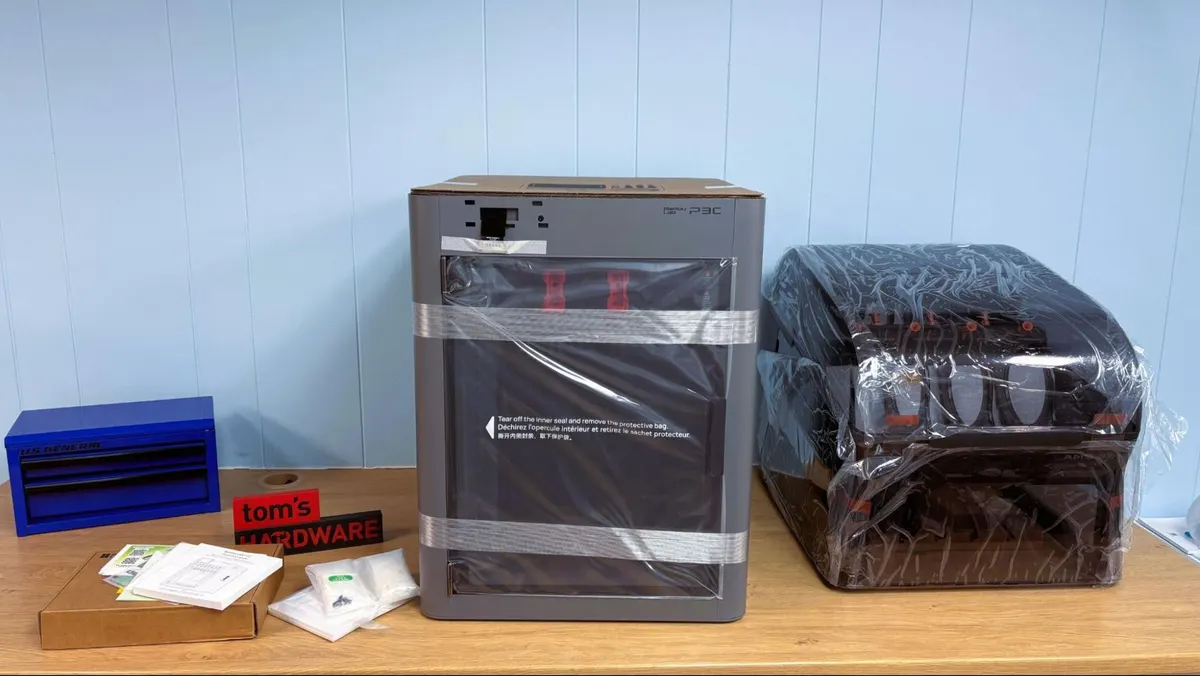
Image: Tom's Hardware

Tom's Hardware has reviewed the Bambu Lab P3C, a smaller and cheaper sibling of the H3C that launched on 24 November 2026 at $1,149 for the five-tool version and $1,299 for the seven-tool version. The reviewer praises the FlexFeed extruder and reliable printing, but criticises the unpowered AMS 3P, which forces manual filament loading, and the large vertical clearance it needs.

Key facts
  • Launched 24 November 2026 at $1,149 (five tools) and $1,299 (seven tools)
  • Build volume 256 x 256 x 260 mm, nozzles 0.2 to 0.8 mm
  • AMS 3P has no motor and needs about 1,212 mm of vertical clearance
  • Optional 75 C dryer costs $159.90

Context A tool changer swaps complete print heads, each with its own heater and nozzle, during a job, which allows several materials or nozzle sizes in one print without purging through a single nozzle.

What the P3C offers

The P3C is a desktop FDM printer with a rack of swappable tools. It has a build area of 256 x 256 mm with 260 mm of height, close to the P2S and smaller than the H3C at 330 x 320 x 325 mm. It ships either with five tools, leaving two slots free for later additions, or as a seven-tool multi-material set with six 1.75 mm tools and one 2.85 mm tool. The larger set includes a 2.85 mm TPU 75A filament, a soft material Bambu is reviving the older filament diameter for. Pricing is $1,149 and $1,299, against $2,499 for the H3C.

How the tool system works

Under the Swaptek system, each tool carries its own filament path, heater and hardened steel nozzle, while fans and the extruder stay on the toolhead. Idle tools are preheated, which makes swaps fast. Nozzle sizes from 0.2 to 0.8 mm can be mixed within one print. The FlexFeed extruder with Active Grip Control uses motor feedback and can switch between 1.75 mm and 2.85 mm filament on the fly. The reviewer calls it possibly the best extruder he has tested. TPU can bypass the tube on most slots, which reduces friction. Bambu plans further tools for cutting, drawing, debossing and foil transfer.

Where costs were cut

The AMS 3P has no motor, so filament must be fed by hand to the nozzle and retracted by hand on unloading, which is slow when all slots are filled. The upside is that almost any spool up to 1 kg fits. There is no filament dryer in the box; an optional 75 C dryer costs $159.90. The chamber is enclosed and filtered but not actively heated, with limits of 300 C at the nozzle and 110 C at the bed. No USB stick is included for time-lapse recording.

Practical drawbacks

The AMS needs about 1,212 mm of vertical space to open its lid, only 3.58 inches less than the H3C, so a step stool or the optional rolling cart is advisable. Changing tools means removing the front cover, with little working room and sharp plastic edges, so the reviewer suggests settling on one configuration. Bed levelling runs at every print start and worked flawlessly. The reviewer reports very few failures even with technical filaments, yet does not rank the P3C among the best printers of 2026.

What it means

For industrial users this is mainly a desktop product, relevant for prototyping, jigs and soft-material parts such as TPU rather than qualified production. The review shows where a lower price comes from: manual filament handling and no dryer add labour and accessory cost, and tool changes are awkward. Buyers weighing several-material prototyping on a small budget should count setup time and space, not only the list price. It follows the earlier launch coverage of the P3C.

Earlier on AddiWire

Frequently asked questions

How much does the Bambu Lab P3C cost?

The five-tool version is priced at $1,149 and the seven-tool multi-material version at $1,299. The larger H3C lists at $2,499.

What is the main drawback of the AMS 3P?

It has no motor, so filament must be loaded to the nozzle and unloaded by hand. It also needs about 1,212 mm of vertical clearance to open the lid and ships without a dryer.

Which materials and nozzle sizes does the P3C support?

It lists PLA, TPU, ABS, ASA, PA, PC, PET and fibre-reinforced filaments, with nozzles from 0.2 to 0.8 mm. An optional 2.85 mm tool handles soft TPU.

Read the original reports
  1. Tom's Hardware 3D printing, 24 Nov 2026