AddiWire

Additive manufacturing news, prices in the EU and the USA, and independent expert commentary

Desktop 3D printing

Bambu Lab P3C puts a seven-tool changer on the desktop from $1,149

Published 4 sourcesSummary written with AIDeutsche Version
Bambu Lab P3C puts a seven-tool changer on the desktop from $1,149
Image: Bambu Lab

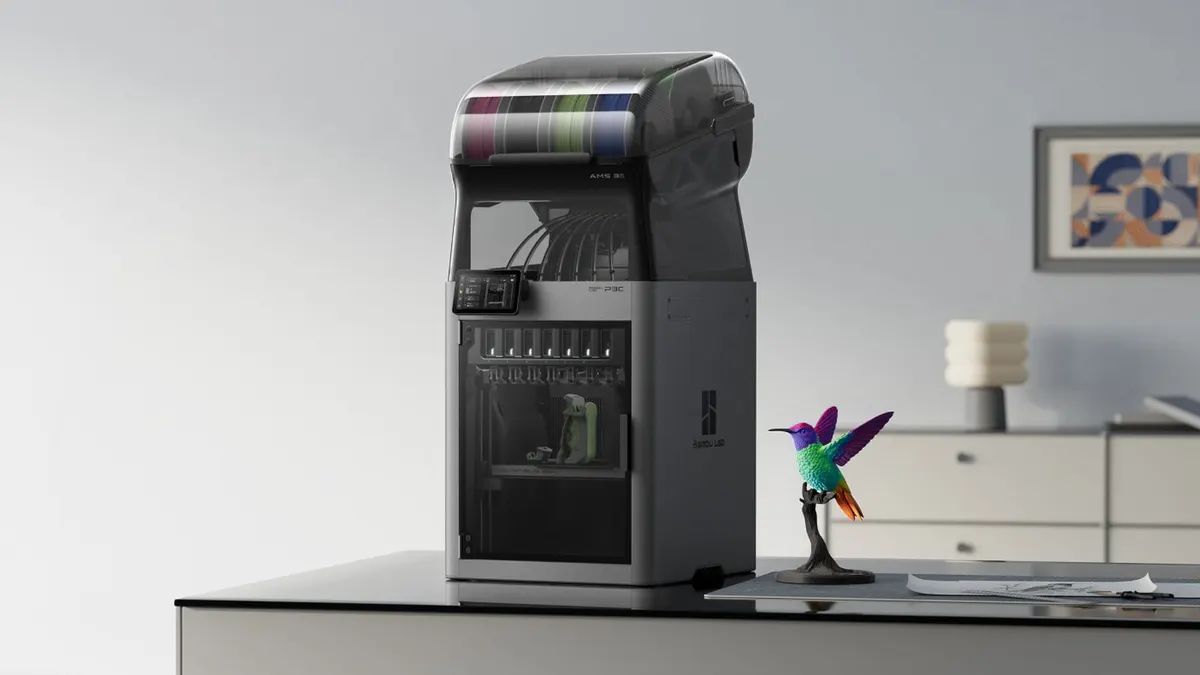
Bambu Lab has launched the P3C, a desktop FDM printer with the Swaptek tool changer from its H3C, priced from $1,149 against $2,499 for the H3C. It holds seven PrintTools, five installed and two open slots, and swaps materials in 6 seconds. It was available worldwide from 24 November 2026.

Key facts
  • Price from $1,149 excluding tax; the H3C is listed at $2,499
  • Seven tool slots: five PrintTools installed, two open
  • Material change in 6 seconds with pre-heating and minimal purge
  • Build volume 256 × 256 × 260 mm; up to 22 colours with external AMS units

Context A tool changer swaps whole print heads automatically, each with its own nozzle and filament path, so a single job can combine materials without purging a shared nozzle.

What does the P3C offer?

The P3C uses the third-generation Swaptek architecture of the H3C, which Bambu Lab lists at $2,499. It has seven tool slots: five PrintTools with 0.4 mm nozzles and a 1.75 mm filament path come pre-installed, and two slots stay open. Buyers can fill them with further PrintTools, for example one for 2.85 mm flexible filament, or with CutTool, DrawTool and DebossTool for cutting, drawing and embossing.

The AMS 3P filament system is integrated and stores seven spools in enclosed compartments. An optional two-slot dryer runs up to 75 °C, and an optional buffer on PrintTool No. 1 allows up to four external AMS units and up to 22 colours. The FlexFeed extruder takes 1.75 mm and 2.85 mm filament; the larger diameter is meant for soft TPU up to 75A at higher flow. All nozzles are hardened steel, rated for carbon and glass fibre filled materials.

How does the tool changer work?

Each PrintTool has its own filament path, heater, power and data connection. The system looks ahead, pre-heats the next nozzle while the current tool prints, and reads temperature with a contact sensor. Bambu Lab says a material change takes 6 seconds with minimal purge, and contrasts this with passive systems that heat only after pick-up and use infrared sensors.

A retractable rack moves along Z to hand over tools and clears the filament tubes from the print area afterwards. Bambu Lab says the design uses more mechanical parts on purpose, in return for faster switching and consistent results over long runs. Nozzles of 0.2, 0.4, 0.6 and 0.8 mm can be mixed in one job.

Specifications, software and price

Build volume is 256 × 256 × 260 mm, maximum nozzle temperature 300 °C and bed temperature 110 °C, with toolhead speed up to 1,400 mm/s. The printer has auto-calibration of tool offsets, AI monitoring with a camera, and an updated error system with on-screen troubleshooting. Optional extras include a Bambu Station and an E1 Air Purifier with HEPA H11 filtering.

The P3C AMS Combo, with printer, AMS 3P and five 0.4 mm PrintTools, costs $1,149 excluding tax with free shipping. Prices in other markets are to follow on regional storefronts. VoxelMatters notes the H3C uses a nine-tool layout.

What it means

For industrial users this is mainly a signal about price pressure in tool-changing FDM, not a production system. Multi-material jobs, such as rigid parts with soft TPU in one build, could cut assembly steps for fixtures, grips and prototypes, but the sources show only consumer examples and no data on repeatability or material qualification. Small manufacturers weighing it for jigs or prototyping should test tolerances and long-run reliability themselves. It follows the earlier AddiWire review of the P3C, which weighed the lower price against AMS automation.

Earlier on AddiWire

Frequently asked questions

How much does the Bambu Lab P3C cost?

The P3C AMS Combo, with printer, AMS 3P and five 0.4 mm PrintTools, has a suggested price of $1,149 excluding tax, with free shipping. Other markets will get prices on regional storefronts.

How does the P3C differ from the H3C?

It shares the Swaptek core and 6-second switching, but sells for about half the H3C's $2,499. VoxelMatters reports the H3C is built on a nine-tool layout, while the P3C has seven slots.

Can the P3C print abrasive filaments?

Bambu Lab says all P3C nozzles are hardened steel with a hardness of HRC 55+, suitable for carbon and glass fibre reinforced filaments.

Read the original reports
  1. Bambu Lab blog, 24 Nov 2026
  2. PR Newswire manufacturing, 24 Nov 2026
  3. VoxelMatters, 24 Nov 2026
  4. Tom's Hardware 3D printing, 24 Nov 2026