AddiWire

Additive manufacturing news and European prices, with independent expert commentary

Industrial AM

Omni3D lists five engineering rules for printing production jigs and fixtures

Published 1 sourceSummary written with AIDeutsche Version
Omni3D lists five engineering rules for printing production jigs and fixtures
Image: Omni3D Sp. z o.o

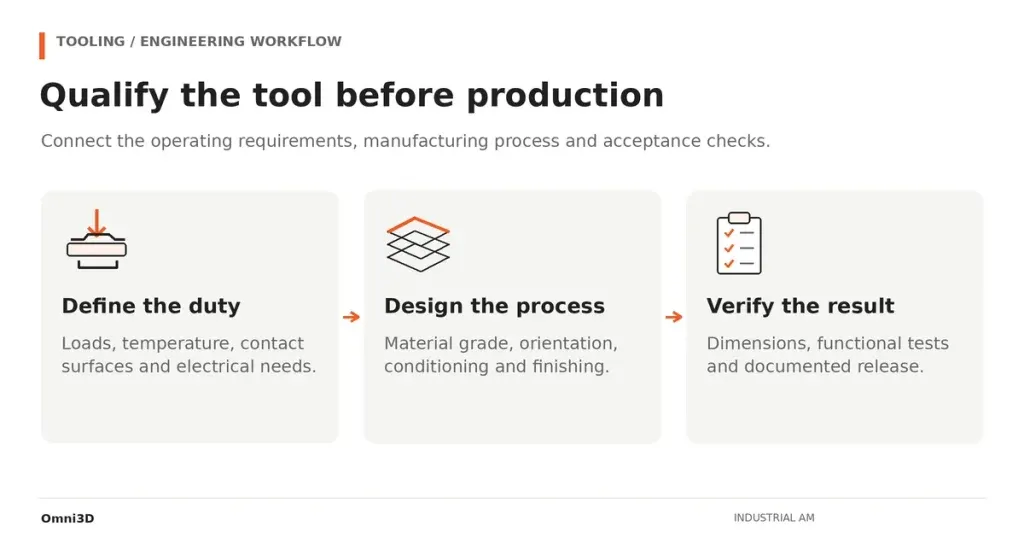
Omni3D has published a five-step guide to designing polymer jigs and fixtures for industrial FFF. It covers working conditions, load path and orientation, material and thermal control, replaceable contact interfaces and ESD qualification. The guide stresses that datasheets only screen candidates and that acceptance tests should come from the real manufacturing operation.

Key facts
  • Omni3D guide sets out five rules for polymer tooling made by FFF
  • Example materials: CF PA-12 for stiffness, ABS ESD for electrostatic control
  • Omni TECH+ is named as a platform to evaluate for these materials
  • Cost is judged per accepted tool, including rejected builds

Context FFF (fused filament fabrication) is a material extrusion process; ESD means electrostatic discharge, which electronics tooling must control through dissipative materials and grounding.

What conditions should a printed fixture be designed around?

The guide starts with the operation: what the tool locates, supports or clamps, which forces and contact points apply, and how much movement is allowed. A fixture that stays intact can still fail if it deflects too far. Continuous loads should be recorded apart from short peaks, along with exposure to cleaners, oils, heat and repeated handling, using temperature and duration together. Datasheets shortlist materials, but the final choice must reflect the printed configuration and real use.

How do orientation, material state and thermal process matter?

Build orientation is treated as an engineering decision. Loads should be checked against deposited paths and layer interfaces, and orientations compared before a build, since the best load path may add supports or hide a locating surface. More infill does not replace a designed structure, and no generic Z-strength reduction is a dependable design value. An acceptance test, such as a loaded dimensional check or endurance run, should be defined before printing.

Material drying, storage and the printing environment belong in the manufacturing plan. The guide cites NIST research on polycarbonate showing temperature and moisture can change geometry and properties, but not as a recipe for other polymers. Nozzle, platform and chamber settings are separate parameters, and fibre-filled grades need abrasion-suited extrusion hardware with wear checks.

What about inserts, ESD and cost?

Printed bodies can carry metal or polymer inserts, bushings, pins and replaceable pads, so wear parts can be swapped while the main structure stays in service. These interfaces should be planned in CAD, including fastening method, wall thickness and any finishing allowance.

For electronics tooling, the finished, assembled and grounded fixture should be assessed within the site's ESD programme, since a filament name alone proves nothing. Batch, profile, orientation and finishing should be recorded. Cost should be compared per accepted tool, covering the whole route including rejected builds.

What it means

The guide is a vendor perspective, but its core points hold for any SME using FFF for tooling: define acceptance criteria before printing, treat orientation and drying as controlled process steps, and count rejected builds in cost per tool. Tooling is a low-risk entry to AM since it rarely needs formal part certification, yet ESD fixtures still need documented checks. Datasheet values alone are not design data, so a small test series on the real fixture is the realistic first step.

Frequently asked questions

Which materials does the Omni3D guide mention?

It names CF PA-12 for cases where stiffness and low mass matter, ABS ESD for electrostatic requirements, and high-temperature polymers where the environment justifies their processing demands.

Can a datasheet decide the material for a fixture?

No. The guide says a datasheet only helps screen candidates, and the final selection must account for the printed configuration and actual use of the tool.

How should cost be compared?

Per accepted tool, covering design, material preparation, printing, supports, finishing, inserts, inspection and rejected builds.

Read the original reports
  1. Omni3D Sp. z o.o, 15 Oct 2026