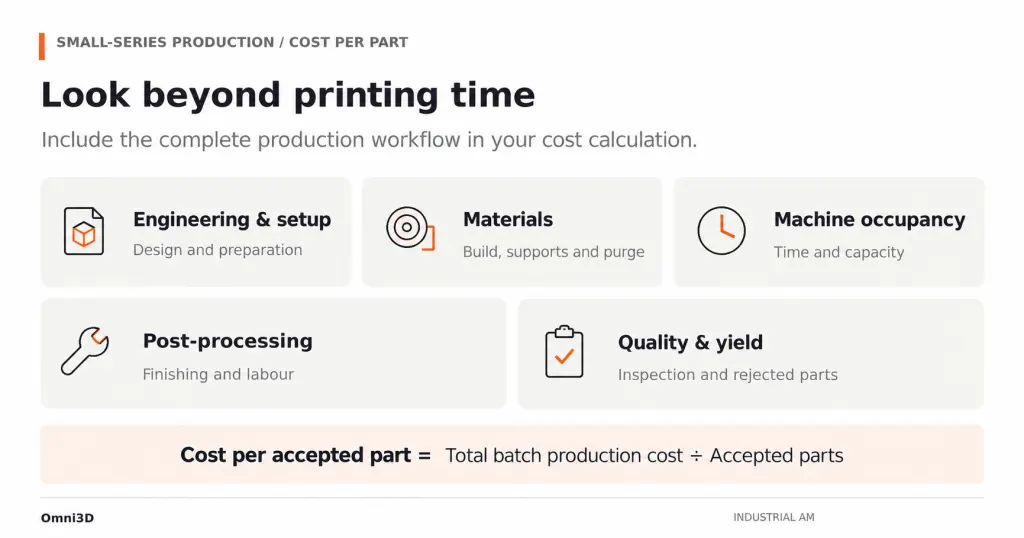
How should cost per part be calculated?
Omni3D proposes a batch-level formula: total production cost divided by the number of accepted parts. The cost base should include engineering and setup, structural, support and purge material, machine time, labour, post-processing, inspection and rejected builds. Reusable engineering work is spread over a realistic quantity, and the accounting boundary must stay the same when comparing FFF with machining or molding. A faster build can still cost more if it needs extra finishing or yields fewer good parts.
Flow, thermal control and supports
Higher programmed print speed does not raise deposition if the hotend cannot melt enough polymer. Omni3D advises checking the sliced toolpath to see whether volumetric flow is the real limit, and comparing settings on the same material, geometry and acceptance criteria. The Omni PRO HT has a heated chamber rated to 220°C and a head temperature up to 500°C, which the company says does not by itself validate a flow rate or mechanical performance for any filament grade. For dual extrusion, its ABS tooling case with ODS-20 soluble supports is an example, not proof for other polymers. Total support cost should include material, tool changes, purge, removal labour and washing equipment.
Metal, qualification and trial design
The Omni M280 LPBF system offers a 280 × 280 × 500 mm build volume with one 500 W laser, and two or four lasers as options. Omni3D holds NCAGE code 9BT1H, which it notes identifies the company but certifies no printer or part. For demanding uses, the text says to link design revision, material batch, printer configuration, build settings, post-processing and inspection records. Trials should use a representative part and fixed batch size, measure accepted parts per elapsed time, and test the ROI model against lower utilisation and yield.