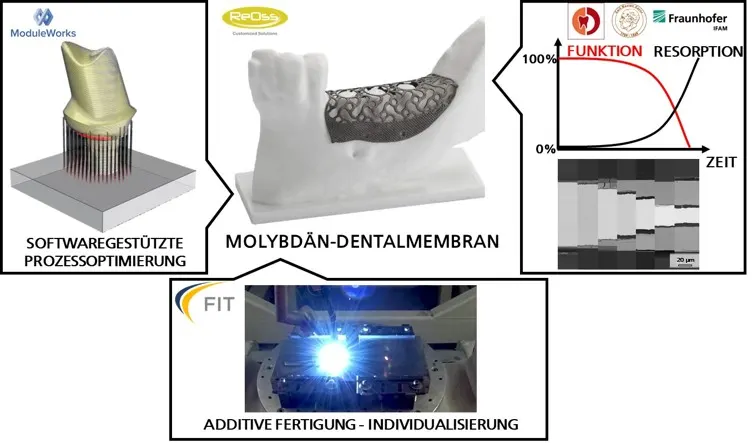
A German research consortium is working on patient-specific dental membranes made of molybdenum that the body slowly absorbs. FIT AG, ModuleWorks and Fraunhofer IFAM Dresden, funded by the BMBF, want to raise the weak strength and ductility of laser powder bed fusion molybdenum. The project runs from April 2025 to March 2028.
Why molybdenum for membranes?
The project, AMoreDentaL, treats molybdenum as strong, well tolerated and able to degrade evenly in the body. The target use is custom membranes that guide bone rebuilding in jaw surgery, where Germany sees about 136,000 cases and EUR 68 million in yearly revenue.
How will the material be improved?
Printed molybdenum is currently too weak and not ductile enough. The partners will adjust powder selection, alloying, laser parameters and post-processing, supported by simulation-based process planning. ReOss then designs and prints functional prototypes, which will be tested in animal models by the Dresden jaw surgery clinic.
What it means
This is early-stage research with animal validation still ahead, so no clinical product should be expected before the project ends in 2028. For manufacturers, the relevant signal is that degradable metals beyond magnesium and zinc are being explored for LPBF. Any resulting implant would face medical device qualification and biological evaluation, which adds years and cost beyond the printing itself.
Frequently asked questions
Who is involved in AMoreDentaL?
FIT AG, ModuleWorks and Fraunhofer IFAM Dresden are the partners, with ReOss handling design and prototype printing. The BMBF funds it under KMU-innovativ.
When does the project run?
From April 2025 to March 2028.