Why does the design question change with additive manufacturing?
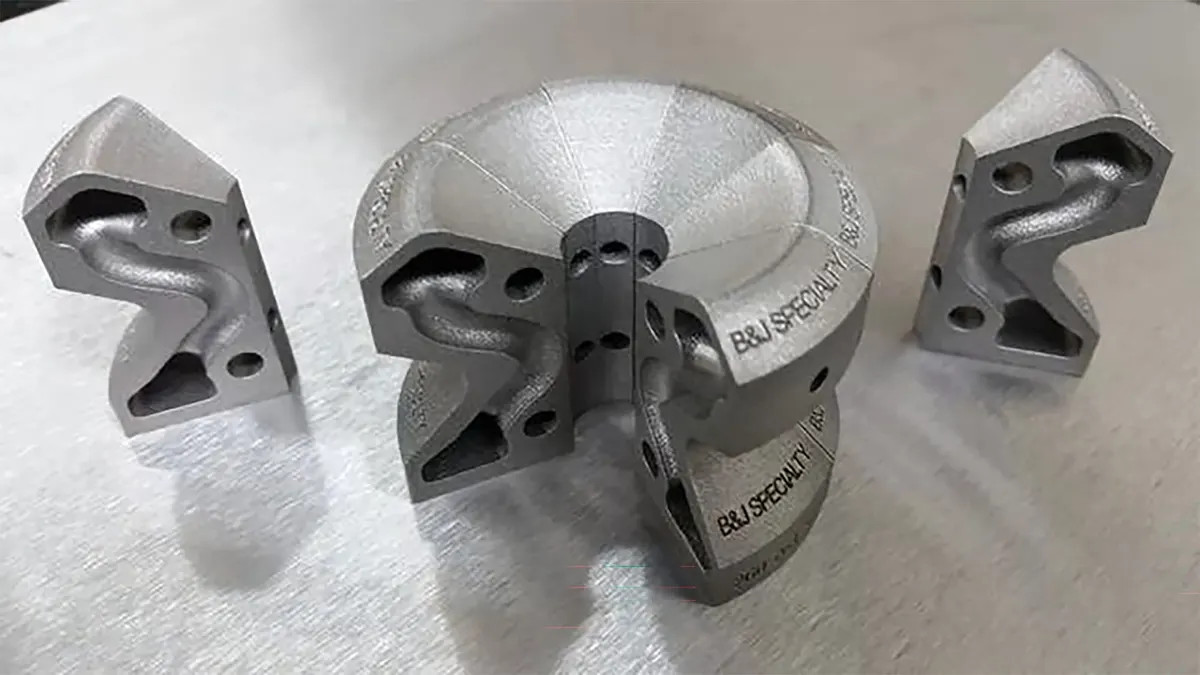
Blain notes that conventional processes force designers to work around tool access, draft angles or mould requirements. Additive manufacturing places material directly from 3D data, which opens up topology optimisation, lattices, internal channels, conformal cooling, lightweighting and part consolidation. His central question: what would engineers design if conventional constraints were not the starting point?
What matters once AM moves into production?
Geometry alone is no longer enough. In LPBF, powder properties, laser settings, scan strategy, thermal history and build environment all shape microstructure and mechanical properties. Process characterisation, parameter control, material traceability, dimensional checks, mechanical testing and qualification therefore move to the centre. Simulation, process monitoring and metrology could be tied into one data chain, which matters most when moving from development builds to serial output, where one good part proves feasibility but not control.
Where could AI and digital inventory fit in?
The author sees machine learning helping to find patterns in process data, speed up parameter development and flag deviations earlier, and generative design bringing manufacturing limits into the first design step. He stresses this does not replace the engineer. On inventory, qualified parts could be held as controlled digital packages with geometry, material specification, process parameters and inspection requirements, and produced where and when needed. He names aerospace, defence, energy and transport as likely beneficiaries.
Which metrics should replace cost per build?
Blain argues that platforms will be judged by utilisation, yield, repeatability, post-processing, inspection, labour, material efficiency and finally cost per qualified part, a higher bar than cost per build. He concludes that the key innovation may be the manufacturing system around the printer rather than the printer itself.