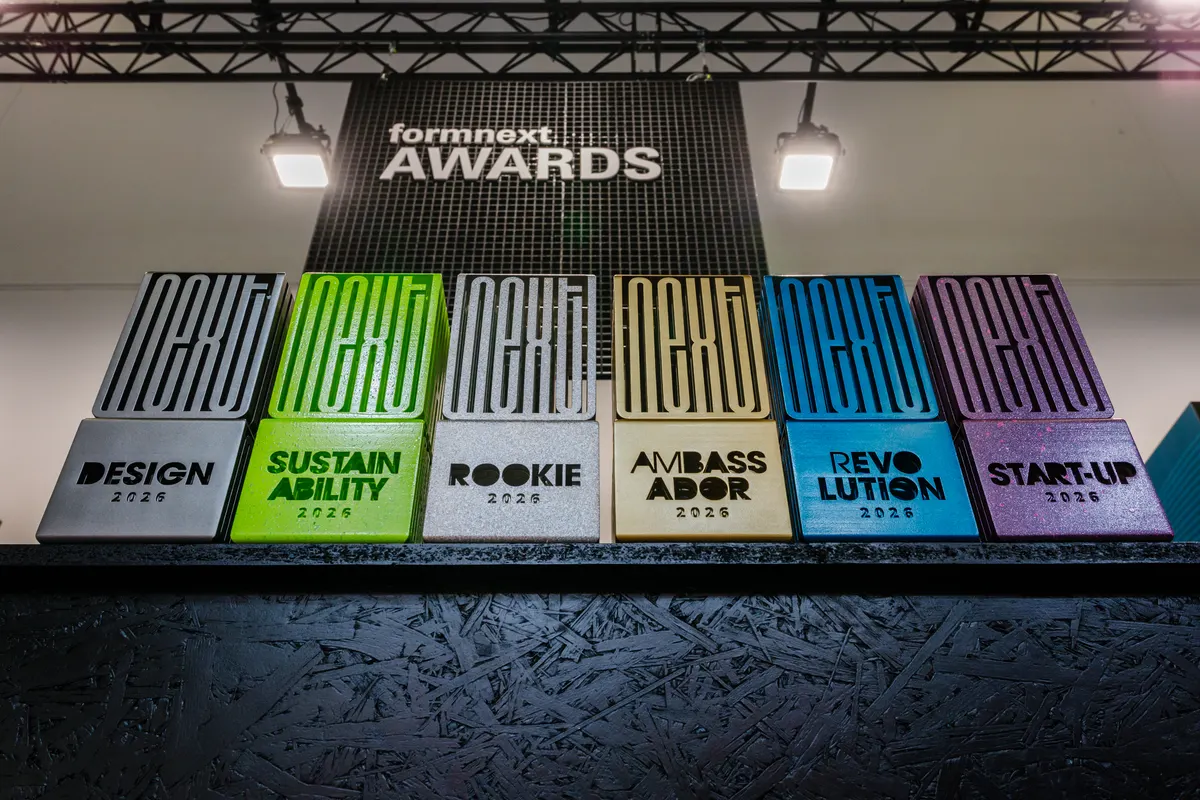
Who won the six categories?
Dr. Michael Kraemer of the Additive Manufacturing Center at TU Darmstadt took the AMbassador Award for education and workforce development. Maya Kaplan won the Design Award for Computational Bra, a master's project at the Technion in Israel. Thought3D from Malta won the (R)Evolution Award, the Munich project cAIclone the Rookie Award, Swiss start-up sallea the Start-up Award, and FlexCycle Solutions the Sustainability Award, supported by Renishaw.
The jury evaluation was combined with a public vote, on site and online, which counted like one additional jury member. Winners received cash and non-cash prizes funded by Renishaw and the Fomas Group, plus a 3D printed trophy designed by Sutosuto and produced by FKM Sintertechnik.
Which technologies were recognised?
Thought3D's Drywise treats only the filament section just before extrusion, holding the required moisture level during the whole print. The company says this can improve part quality and mechanical performance of engineering polymers such as nylon, while cutting the time and energy of conventional drying. VoxelMatters notes it also reduces energy use compared with drying ovens.
sallea develops 3D printed wash-out tooling and cores for lightweight parts with complex geometry, suited to thermoset CFRP in motorsport and sporting goods. FlexCycle Solutions, a spin-off from TU Bergakademie Freiberg according to VoxelMatters, uses a purely mechanical process, without melting, to turn electronic waste into copper powder for AM and powder metallurgy. Its spherical-rough particle shape improves laser absorption in LPBF.
What about the people and design projects?
Kraemer's centre supports about 50 to 60 students a year, has contributed to ten PhD theses in three years and helped set up AM training for technical apprentices with IHK Rhein-Main. Kaplan's bra is made from a single TPU material on a desktop FDM printer, with elasticity, support and compression built into the textile structure. cAIclone, still in the pre-founding stage, combines CFD simulation, Bayesian optimisation and AM to design hydrocyclones for separating particles of 1 to 50 µm, first for battery recycling.