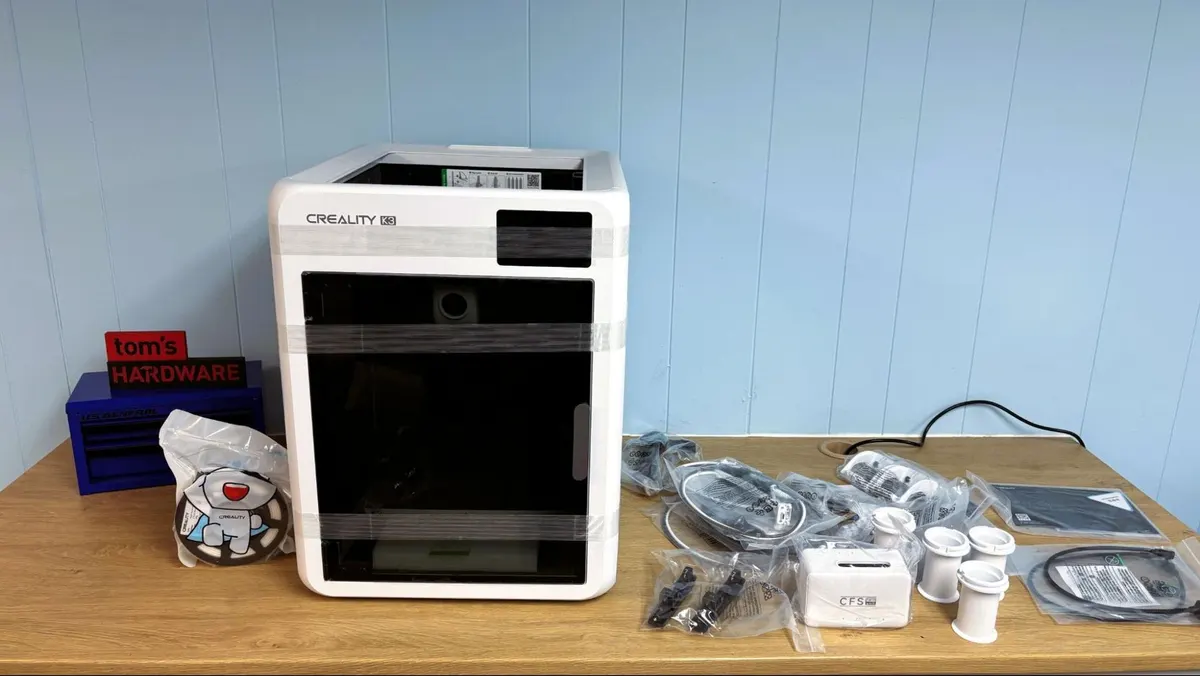
What the K3 offers
The K3 carries four tools, each with its own ceramic heater, a nozzle with a hardened steel insert and a separate filament path. The KliTek system allows different nozzle sizes and materials in one print, though the reviewer found the mixed nozzle option less practical than it sounds. The printer still uses a purge tower for multicolour prints, but the reviewer says it wastes far less filament than AMS-style colour systems. Colour blending in Creality Print, which stacks thin layers to create the optical impression of new colours, follows the approach of Snapmaker's open-source Full Spectrum.
The rest of the machine shares its design with the K2: a metal frame with white plastic cladding, a glass door, a Core XY motion system and a 4-inch touchscreen. Build volume is 260 x 260 x 260 mm, and filled filaments are supported up to 300 °C.
Test results and criticism
The reviewer reports that the tool changer never dropped or misplaced a tool, and that there was not a single bad print, even at higher speeds. Creality built in 37 sensors, 12 of them for tool swapping. An AI camera checks for build plate, foreign objects and spaghetti failures and gave no false positives. Bed levelling runs automatically and can be repeated before each print.
Criticism centres on the side-mounted spool holders, which are too large for many cardboard spools from Prusa and others. Polymaker and Bambu spools fit. The open-top design makes the printer loud, and the lid needed for high-temperature filaments was not available. Creality says it will ship with a TPU kit that swaps the CFS Nano for a CFS Flex and adds dry boxes and a high-flow nozzle. The slicer, Creality Print 7.3, was missing a filament mapping button for the K3 at review time. The printer is priced at $849 on preorder, and the reviewer sees no new offer in a crowded tool changer segment.