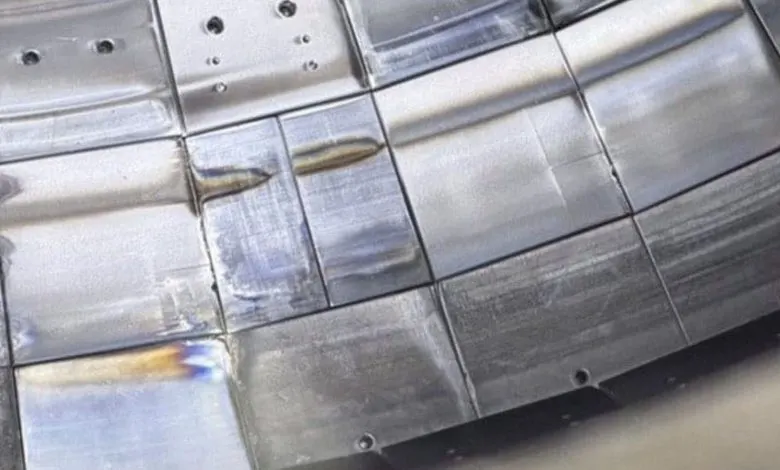
NC State, Oak Ridge National Laboratory and JEOL made full-scale tungsten tiles by electron beam powder bed fusion and mounted them in the DIII-D tokamak in San Diego. The parts withstood 74 high-confinement plasma discharges without damage. It is an early sign that printed tungsten can serve in fusion machines.
Why is tungsten hard to print?
Tungsten melts at 3,422 °C, the highest of any metal, but it turns brittle and cracks at low temperatures. Laser-based attempts have mostly produced porous, cracked parts. In the electron beam process, the beam keeps the surrounding material above about 1,400 °C, which limits cracking.
What was tested?
The tiles went into the lower divertor, which absorbs much of the plasma exhaust heat, in July. Printed test buttons in 2025 had already seen heat loads near 20 MW per square metre. The new tiles measure about 140 by 130 mm, against a prior NC State maximum of roughly 50 mm. JEOL printed flat and domed versions on its JAM-5200EBM in Akishima, funded by ORNL. NC State finished them by wire EDM and CNC grinding, about eight months from invitation to installation.
What it means
For manufacturers outside fusion, this is a materials signal rather than a market. It shows that EB-PBF can handle a crack-prone refractory metal at useful part size. Qualification still rests on exposure data, and future plants need steady loads of 10 to 20 MW per square metre. Small and mid-sized firms are more likely to gain from the process know-how and finishing chain than from near-term orders.
Frequently asked questions
How many plasma discharges did the printed tiles endure?
They came through 74 high-confinement H-mode discharges in the DIII-D tokamak intact.
Who made the tiles?
JEOL printed them in Japan with ORNL funding, and NC State finished them by wire EDM and CNC grinding.