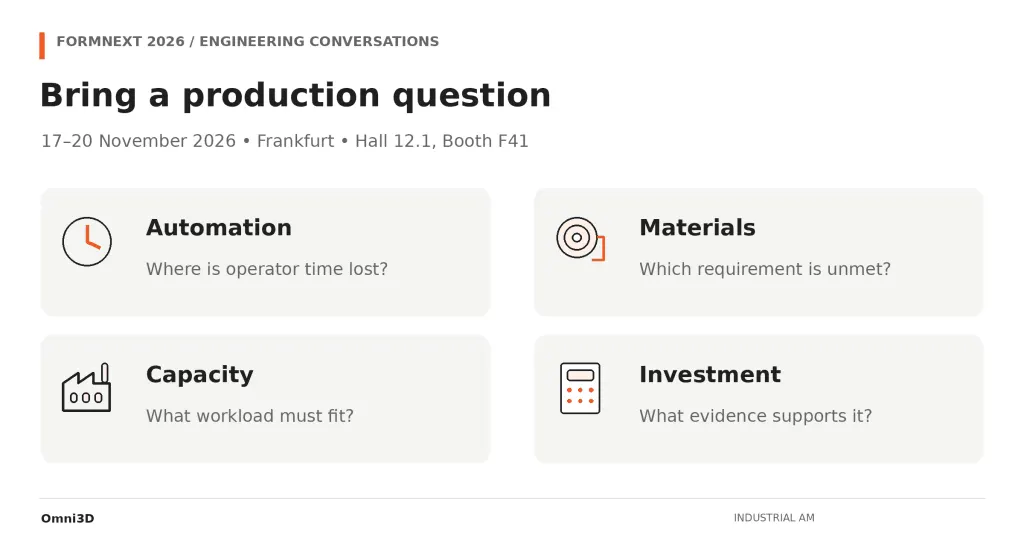
Which four questions does Omni3D put forward?
The first asks where automation would remove a true bottleneck. Omni3D points out that the print cycle is only one step: preparing data, swapping materials, unloading, finishing and checking can each set delivery time, so a faster machine may add little if another stage limits output.
The second concerns materials. Omni3D advises starting from loads, temperature, contact conditions and expected service life, and names its polymer portfolio and the Omni PRO HT platform for higher-temperature work as starting points.
How should capacity and proof of value be judged?
On capacity, the company suggests describing part families, geometry, frequency and delivery dates, including preparation and inspection time. It separates polymer material extrusion from metal LPBF so a factory can see which equipment and skills it needs, and which work stays with a service provider.
On evidence, it recommends ending any evaluation with a testable step, fixing acceptance criteria before the trial, counting the effort per accepted part and keeping measured results apart from demand assumptions. Omni3D also offers engineering and printing services for early-stage applications.