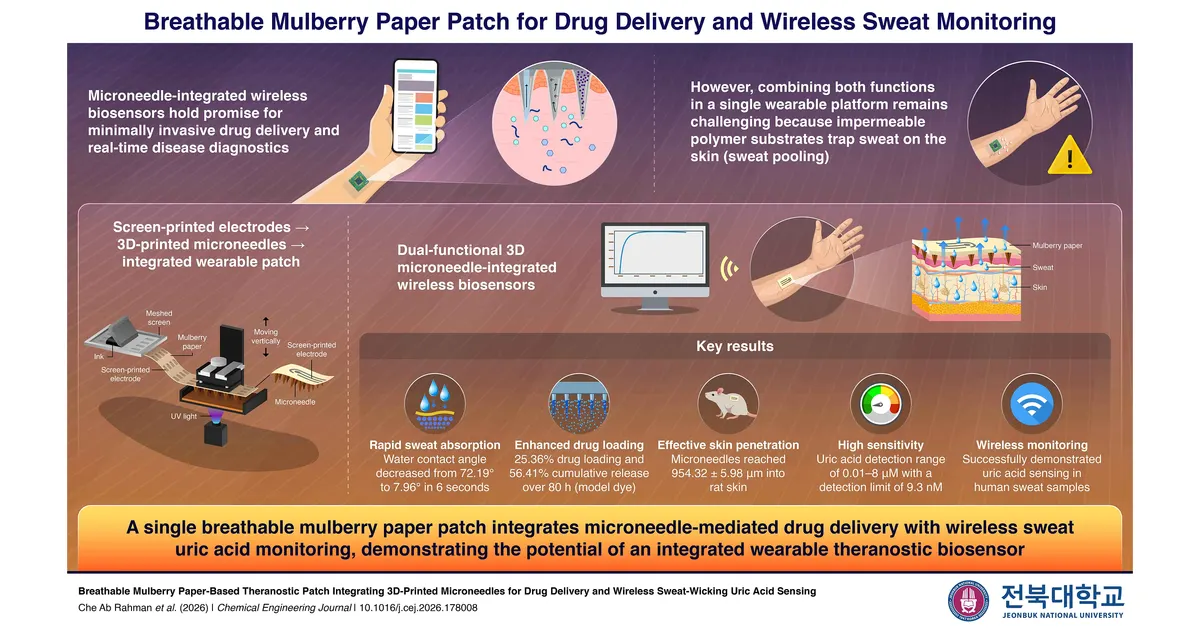
Researchers at Jeonbuk National University have built a breathable wearable patch on traditional Korean mulberry paper. Light-based 3D printing forms microneedles directly on the paper, and printed electrodes detect uric acid in sweat wirelessly. Drug delivery and sensing were tested separately, so the work is a basis for later integrated devices, not a finished product.
How is the patch built?
The team, led by Professor Sooman Lim, used light-based 3D printing to form microneedles directly on hanji paper, without adhesives. Printed electrodes on the same substrate sense uric acid, a marker for gout and hyperuricemia, in sweat. The paper's porous network moves moisture away: water contact angle fell from 72.19° to 7.96° within six seconds.
What did the tests show?
Optimised microneedles held 25.36% drug load against 12.6% for unmodified ones, released 56.41% of a model dye over 80 hours, and penetrated about 954 micrometres into excised rat skin without deforming. The sensor covered a very low concentration range, matched laboratory LC-MS results with 98.1% to 101.3% recovery, dried in 13 seconds and drew 15 mW wirelessly.
What comes next?
Both functions were evaluated separately. Planned work includes tests with clinical drugs, skin-safety studies and real-time on-body trials. The study appeared in Chemical Engineering Journal, Volume 542.
What it means
This is laboratory research, not a product, and drug delivery and sensing were never combined in one test. For manufacturers, the relevant point is that vat photopolymerisation can build functional structures directly on a porous substrate without adhesive, which simplifies assembly. Any medical use would still need skin-safety data, clinical drug testing and device regulation, so realistic timelines run in years. Small companies in medical wearables should treat it as a design direction to watch.
Frequently asked questions
What is the patch made of?
It is built on hanji, traditional Korean mulberry paper, with microneedles printed by a light-based 3D printing process and printed sensing electrodes.
Can it deliver drugs and sense uric acid at once?
Not yet. The two functions were evaluated separately, and integration is a goal for future work.
What are the next steps?
Testing with clinical drugs, skin-safety studies and real-time on-body trials.