Why is PA11 chosen for SLS parts?
According to the guides, PA11 is picked when a part has to do real work: absorb impact, flex without cracking and resist oils, fuels and other media. Typical uses named are brackets, clips, housings, fluid-handling parts and replacement components, as well as functional prototypes. Chemically it is built from 11-aminoundecanoic acid and is commonly positioned as a bio-derived nylon, though the guides note that actual performance depends on the specific grade and a validated process.
The texts also compare it with PA12, the other established SLS nylon. They treat the choice as dependent on grade and system rather than a simple ranking, with PA11 favoured where ductile behaviour is decisive.
Which data should buyers verify?
The guides advise reviewing mechanical, thermal, physical and process-related data separately, and warn that grades, additives and filled variants are not interchangeable. Published values vary with build orientation and moisture state, so datasheets may list different figures for the XY plane and the Z direction, or for dry and conditioned samples. For design approval, the test condition should match the real application, and a single headline strength or elongation figure is rarely sufficient.
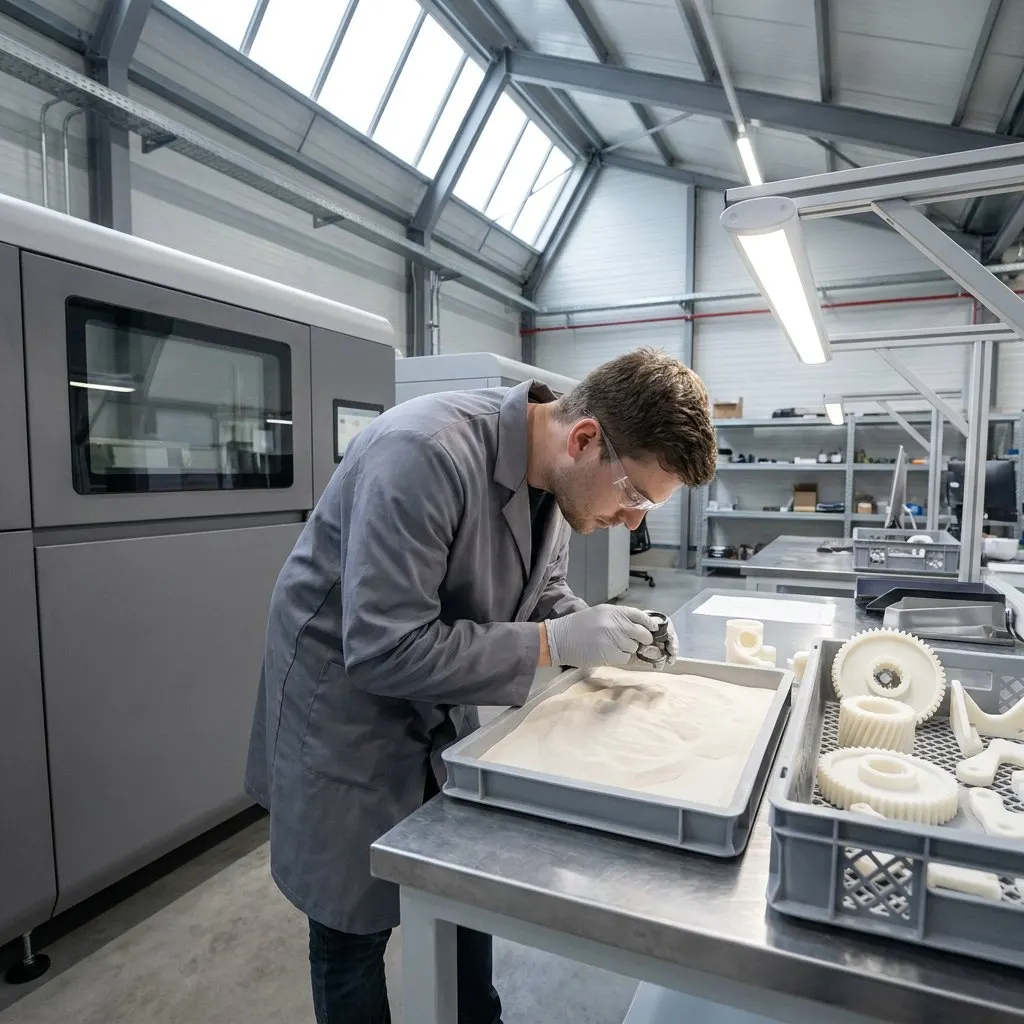
Powder behaviour counts as much as part data: particle size distribution, particle shape, additive package and moisture uptake affect feed, layer spreading and fusion consistency.
How do reuse, storage and machine fit affect results?
Not every PA11 grade can be dropped into any powder-bed machine. Each needs approval for the printer, its parameter set and handling routine, and some materials also depend on a controlled atmosphere such as inert gas. Refresh ratio, the share of fresh powder added to recovered powder, is grade-specific and printer-specific and should come from validated guidance. Branded materials such as PA11 Onyx may have their own rules that do not carry over to other PA11 powders.
Powder should be kept in sealed, dry containers with limited exposure and traceable batch control. Recovered powder needs sieving before reuse, and airborne dust should be controlled with approved industrial vacuum equipment.