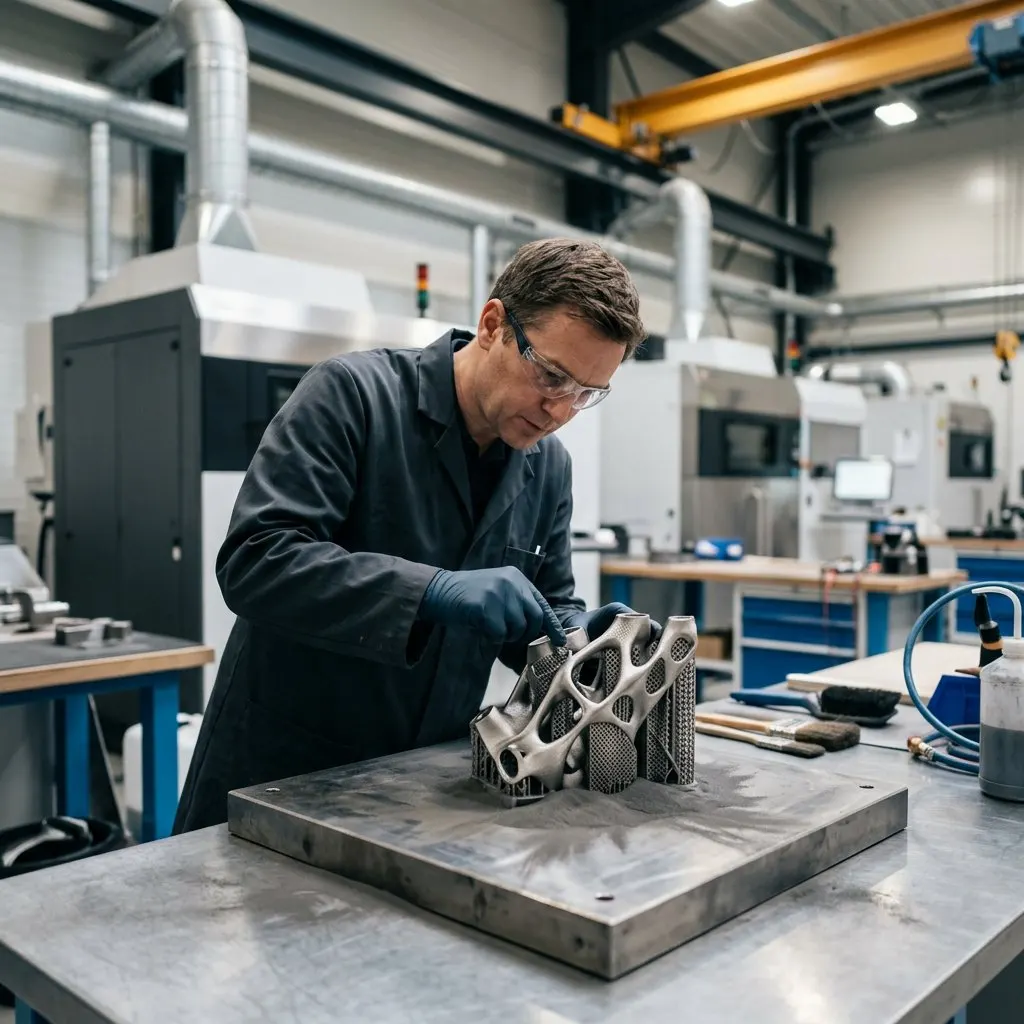
How does LPBF build a part?
A recoater lays a thin powder layer on the build plate, and a laser melts the cross-section of the part along a programmed path. The plate then lowers and the cycle repeats under a controlled atmosphere. Supports manage heat and hold the part in place, and powder removal is a required step after the build.
Which variables shape the result?
The page treats the whole production system as the driver. Even powder spreading depends on round, well graded particles; too many fines, satellites or rough grains can disturb recoating, especially on tall builds. Higher laser power does not automatically raise residual stress: melt-pool stability, scan strategy and heat flow matter more. Thicker layers can lift throughput if density holds, but usually give a rougher as-built surface. That can be acceptable where a face will be machined later.
When does LPBF fit, and what should buyers check?
LPBF suits internal channels, lattices, lightweight structures, consolidated assemblies and low-volume or high-value parts where avoiding tooling helps. It is less attractive for simple, bulky parts, heavy support needs, build-envelope limits or cases where finishing effort and equipment cost outweigh the design gain. When comparing workflows, the page names laser setup and build volume, gas flow and thermal control, powder handling and traceability, software and validated parameter sets, and maintenance and operator training. Common alloys are stainless steels, nickel alloys such as Inconel, titanium and aluminium.