What drove industrial machine growth?
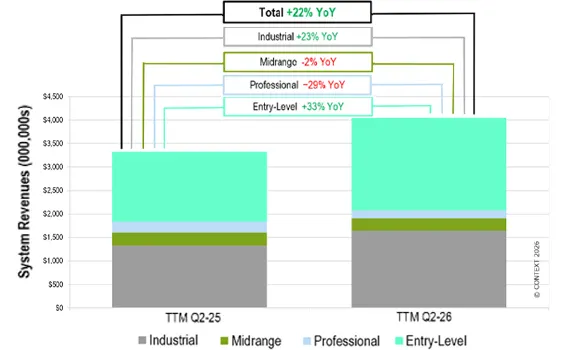
Industrial shipments (machines above $100K) grew 25% in Q2, the fourth straight quarter of growth, and revenue rose 40%. China led trailing twelve month volume with 37%, ahead of North America at 29% and Western Europe at 21%. North American shipments grew 44% and Chinese shipments 42%. Chinese vendors mainly serve their home market, while Western makers supply the US and Europe.
Metal machines made up 53% of industrial units and 75% of industrial hardware revenue. Metal shipments rose 36% and metal revenue 51%, with powder bed fusion holding 77% of metal units and 83% of revenue.
Which vendors and sectors benefited?
Aerospace and defence were the main catalyst for Western makers. EOS reported high double-digit revenue growth, including an order for 30 metal PBF machines from drone maker Beehive Industries. Nikon SLM Solutions also received Beehive orders for its NXG 600E systems, Renishaw doubled its metal PBF shipments, and Arc Impact, owner of Desktop Metal, cited strong US defence demand. Farsoon and BLT grew on titanium foldable phone hinges and smartphone frames.
How did the lower price classes perform?
Midrange machines ($20K to $100K) rose 8% in units and 3% in revenue, with polymer SLS shipments up 38%. Launches such as the Formlabs Fuse X1 and HP Jet Fusion 1200 are expected to add momentum. Professional machines ($2.5K to $20K) fell 13% in units and 24% in revenue, hit by weak legacy FDM. Stratasys' pending Markforged acquisition would consolidate composite extrusion.
Entry-level machines (up to $2,500) grew 23% in units and 36% in revenue, with China making nearly 95% of shipments and four brands (Bambu Lab, Creality, Elegoo, Anycubic) holding 87%. Chinese exports rose 58% to 3.9 million units in the first half, and Creality issued a profit warning citing price competition, which points to a possible gap between shipments and end demand.