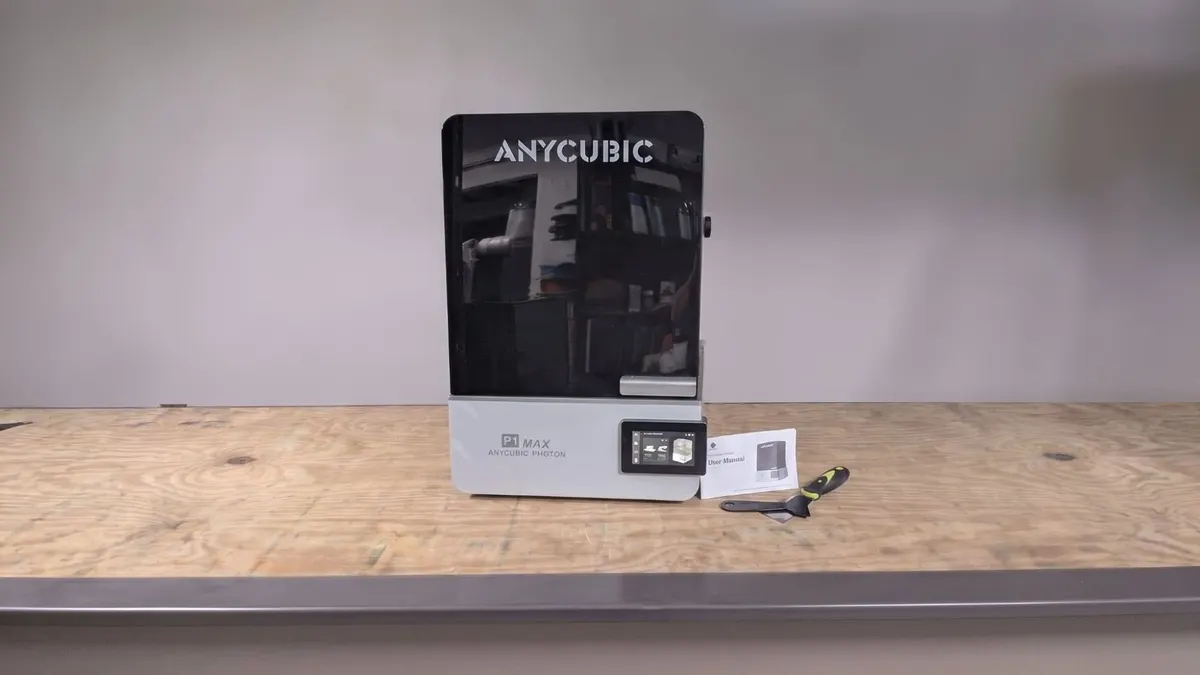
Tom's Hardware has reviewed the Anycubic Photon P1 MAX, a larger resin printer that replaces the Mono M7 Max and shares its design with the smaller Photon P1. It uses a 12K monochrome screen, a heated vat and a screen cover called Wave Release. The reviewer rates it well, but notes early firmware with a leveling glitch.
Key facts
Presale price is $1,103, rising to $1,149 afterwards; release date July 22, 2026
Screen: 1-inch 12K monochrome LCD with 24.8 micron XY resolution
Heated vat holds 35 °C and takes up to 1.9 litres of resin
Test figure at 0.05 mm layers took 7 h 24 min and about $5 of resin
Context Wave Release is Anycubic's name for a special cover over the LCD intended to ease the release of cured layers from the FEP film at the bottom of the vat.
What does the Photon P1 MAX offer?
The printer succeeds the Mono M7 Max and keeps the look and interior of the smaller Photon P1. Its working space measures about 285 x 214 x 300 mm, and the light comes from a chip-on-board source with a reflector and an aspherical Fresnel lens. The screen is a 1-inch 12K monochrome panel with 24.8 micron resolution in X and Y, and a normal exposure time of 2 seconds. A 4.5-inch resistive touchscreen handles control, and files arrive by USB or Wi-Fi. The machine weighs 23.1 kg.
Which hardware details did the reviewer highlight?
The build plate locks with a flip-up lever and the vat slides in and out, so no loose screws are needed. The vat is heated and held at 35 °C, and the reviewer says earlier Anycubic models tended to stop heating after the start. A drop tray catches resin from the build plate, and the vat takes up to 1.9 litres. Wave Release is a special cover over the LCD meant to avoid air bubbles between the FEP film and the screen and so smooth the peel force. Leveling uses a pressure-based assist.
What problems and print results were reported?
The review unit ran early firmware. After auto-leveling the plate rose about 100 mm and needed a second manual adjustment, which the reviewer hopes Anycubic will patch to match the smaller P1. There is a rubber grommet at the back for a fume extraction vent, but no hose is included. In tests with Anycubic standard resin, a split Tyrael figure took 7 h 24 min at 0.05 mm layers and 254 ml of resin, about $5. A scaled-up Lord of Terror needed 14 h 15 min, and a two-part dog mask took 6 h 5 min and 519 ml. Photon Workshop is supplied, and Chitubox and Lychee also support the machine.
What it means
This is a consumer and hobby review, so its direct relevance to industrial additive manufacturing is limited. For small manufacturers, such printers are mainly useful for visual models, fit checks and low-stakes prototypes, where resin cost of a few dollars per part is attractive. They come with no process documentation or material qualification, so they do not suit end-use or regulated parts. The early firmware reported here is a reason to check update status before relying on any machine.
Frequently asked questions
How much does the Anycubic Photon P1 MAX cost?
It is on presale for $1,103 and is expected to rise to $1,149 afterwards. Its release date is given as July 22, 2026.
Which slicers work with the Photon P1 MAX?
Anycubic's Photon Workshop comes on the included USB drive. Chitubox and Lychee also support the printer.
Did the reviewer find any faults?
The review unit ran early firmware and showed a leveling glitch where the plate rose about 100 mm and needed a second adjustment. No exhaust hose is included for the rear vent.