What changes compared with the Plus4?
The Plus5 offers a 320 by 320 by 300 millimetre print space, 20 mm more in each direction than the Plus4, and the review puts the gain at 18% with nearly the same footprint. The machine weighs 29 kg. The hotend reaches 370 °C, the bed 120 °C and the actively heated chamber 65 °C, which the reviewer links to materials such as PPS, PA and PC. The launch price of $749 is $50 below the Plus4 at its launch.
How is it built?
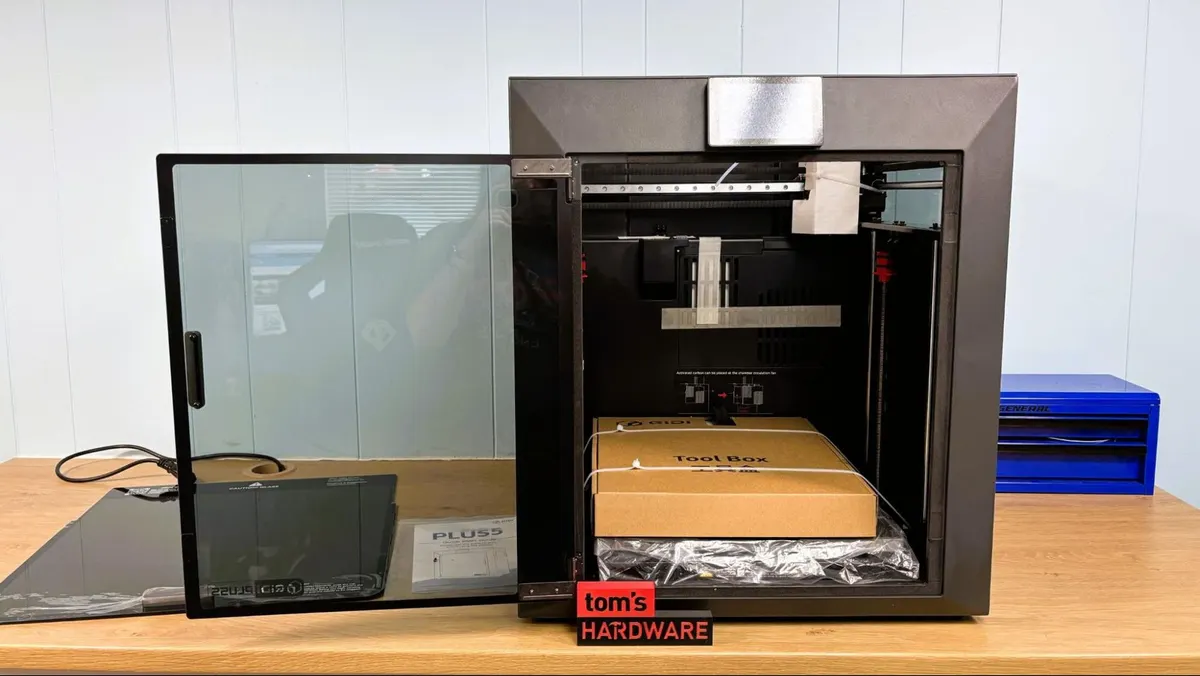
The printer uses a Core XY system with 9 mm belts, a linear rail on the X axis, linear rods on Y and four rods on Z driven by two lead screws. The compact all-metal nozzle, shared with the QIDI Q2, has a hardened steel insert. A HEPA and activated carbon filter at the rear traps fumes from ABS and ASA, and a 1080p chamber camera supports monitoring and AI failure detection. The glass top can slide back for ventilation with low-temperature filaments, and the front door opens 180 degrees. An optional QIDI Polar Cooler blows cooled air onto the extruder to limit heat creep; the reviewer did not test it.
How did it perform in use?
Setup is nearly complete out of the box, and automatic levelling worked reliably. Loading filament is easy from the touch screen, but reaching the Bowden tube at the rear and pushing filament past the coupler is described as awkward. QIDI Studio, derived from BambuStudio, will feel familiar to Bambu Studio and ORCA Slicer users. Test prints in PLA, PCTG, TPU and ASA came out well, with a Benchy in 32 minutes and minor stringing. The reviewer could not test the QIDI Box on the Plus5 and found it lacking on the Q2, noting that more consistent colour swaps would make Bambu Lab's position harder. The source text ends before the review's conclusion.