AddiWire

Additive manufacturing news, prices in the EU and the USA, and independent expert commentary

Research

Printed particle shapes stiffen silicone almost 13 times in Tampere study

Published 1 sourceSummary written with AIDeutsche Version
Printed particle shapes stiffen silicone almost 13 times in Tampere study
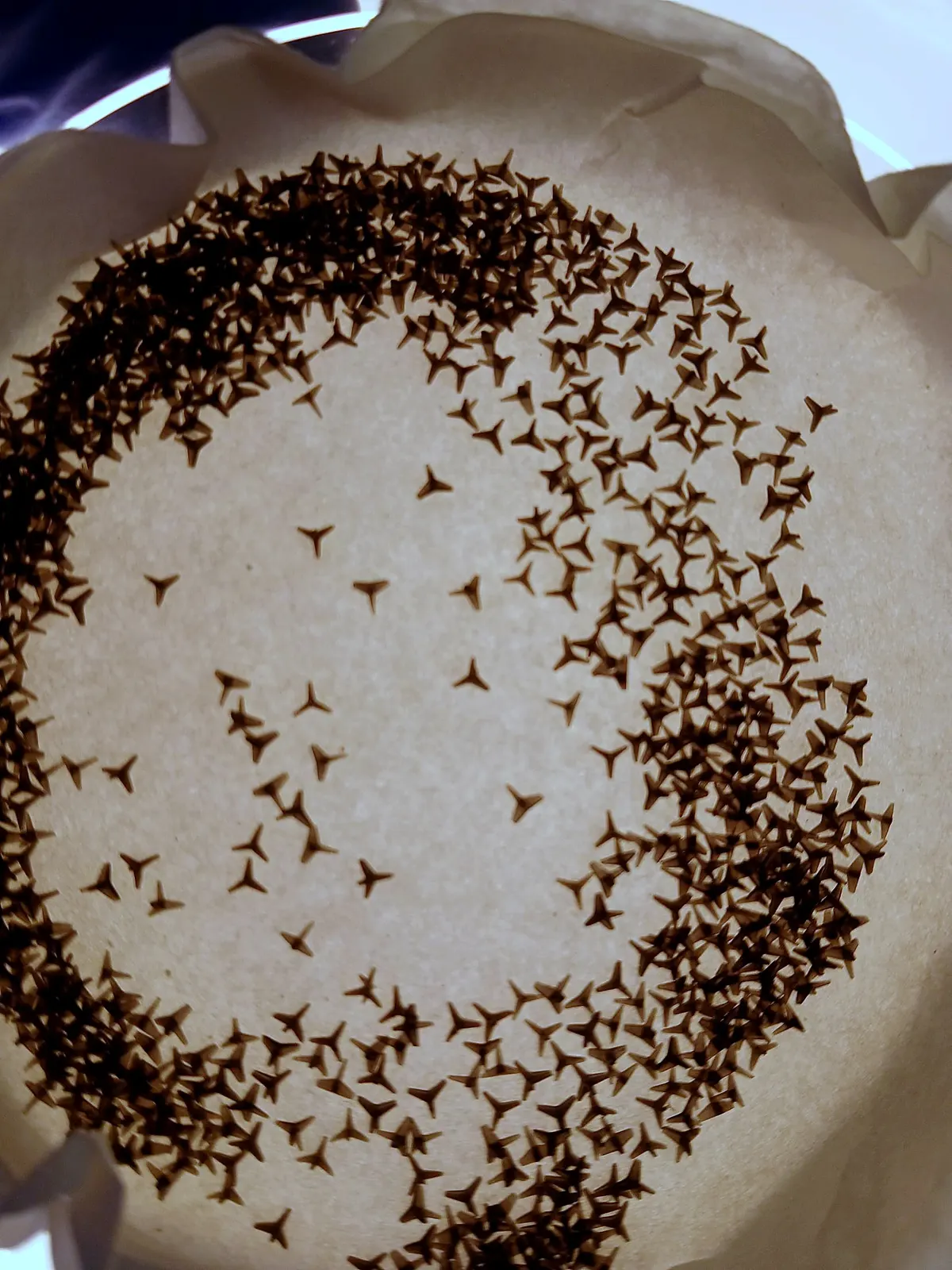
Image: Adel Badria, Tampere University

Researchers at Tampere University printed more than 150,000 tiny plastic particles with DLP and mixed them into silicone, raising its stiffness by almost 13 times. Particle shape mattered more than the amount of filler, with four-armed tetrapods outperforming cubes. The work, published in Materials & Design, points to printing the building blocks of a material instead of the finished part.

Key facts
  • More than 150,000 particles printed with DLP, each under a millimetre
  • Stiffness of the soft silicone rose by nearly 13 times
  • 51 test specimens were compressed; tetrapods beat cubes at lower filler content
  • Published 5 November 2026 in Materials & Design

Context Fillers are particles or fibres added to plastics or rubber to change their properties; "architected" fillers have a three-dimensional shape designed on purpose before they are made.

What did the researchers print and test?

The team, led by postdoctoral researcher Adel Badria, used digital light processing to make particles in batches: cubes and tetrapods, a shape with four arms radiating from a centre, each in two size ranges. The smallest cubes measured 0.31 millimetres across. The particles were embedded in three silicone types of differing stiffness, and 51 specimens were tested in compression.

Tetrapods raised stiffness more than cubes, even with less filler material. The shapes also changed how the composites failed: those with larger cubes kept deforming without needing much more pressure, while tetrapod composites held together better after damage. Badria said the importance of shape was expected, but its size was not. He chose a commercially available resin and silicone so others can reproduce the work.

Why print particles instead of the material?

Instead of printing a whole lattice, manufacturers could print individual particles and mix them in with casting or moulding. This could also help combine materials that are hard to print together, such as hard ceramics and soft polymers. The trade-off is less control over where each particle ends up and how it is oriented.

The main hurdle is scale and price. Badria says this may limit the approach to critical applications for now, while simpler particles of about one cubic millimetre or larger could suit larger-scale production sooner.

What comes next, including medical use?

The idea began with Badria's earlier bone-repair work. At Tampere he is now studying printed hydroxyapatite particles and, in a separate project at an advanced stage, three-armed aluminium oxide ceramic particles made by a collaborator. Neither was part of the silicone study.

Medical use would need cell and animal studies, consistent sterile production and regulatory approval, which Badria describes as years of work. Soft robotics is another target. His longer-term goal is a library of particle shapes that engineers can pick from when designing materials.

What it means

This is laboratory research, not a product, and no cost or throughput data for industrial quantities exist yet. For small and mid sized manufacturers the takeaway is the direction: AM may supply designed building blocks that are blended into conventional casting or moulding, rather than finished parts. That could fit existing process knowledge, but qualification would have to cover the particle supply as well as the composite. Realistic timelines for any regulated use are years, and early adopters would likely be limited to high value, critical parts.

Frequently asked questions

How much stiffer did the silicone become?

The researchers report a stiffness increase of nearly 13 times in the soft silicone, using printed polymer particles as filler.

Which particle shape worked best?

Tetrapods raised stiffness more than cubes, even with less filler material, and held together better after damage.

Is this ready for industrial or medical use?

No. Cost and scale of particle production are open issues, and medical use would need cell and animal studies, sterile production and regulatory approval.

Read the original reports
  1. 3DPrint.com, 25 Nov 2026