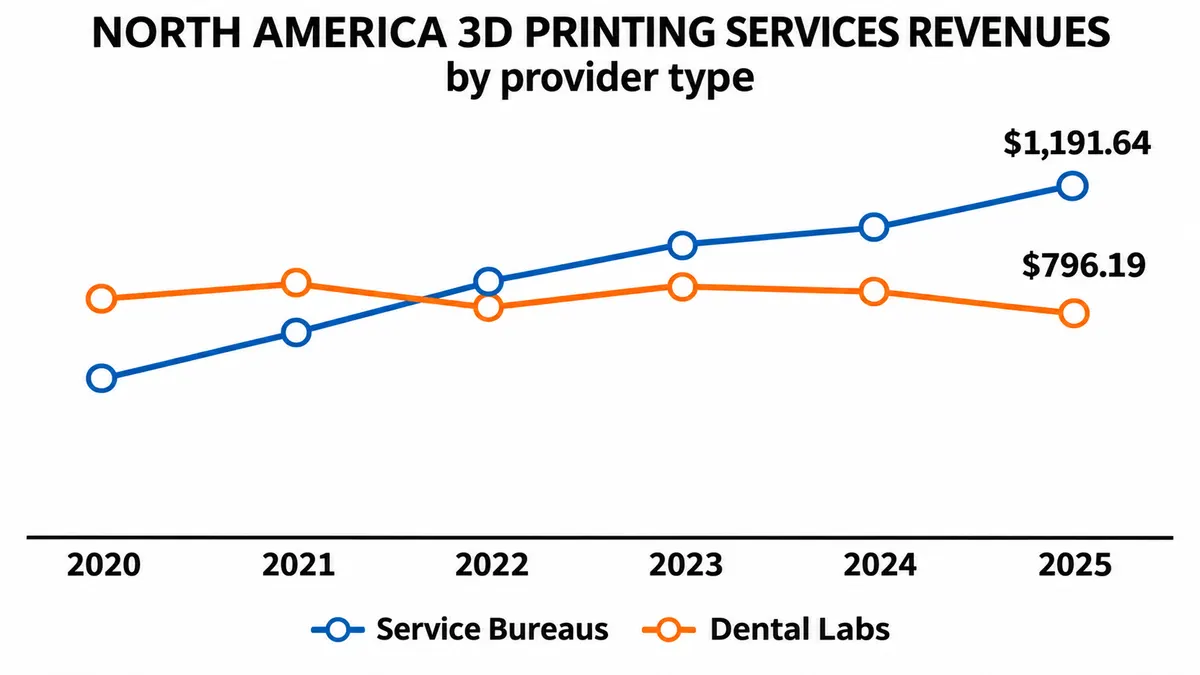
Two segments carry the services market
AM Research is building a regional model of the additive print services market and has started with North America. It counts dental laboratories as service bureaus, since they take orders from dentists and produce the parts. Before 2022, dental labs earned more than all other service providers in the region combined. Since then, service bureau revenue has grown faster, reaching nearly $1.2 billion in 2025.
In 2025, powder bed fusion, metal and polymer combined, accounted for 42% of revenue. Dental lab services, mostly vat photopolymerization and UV jetting with some metal powder bed, took 40%. The two segments barely overlap, because North American dentistry favours printed composites and ceramics for appearance, which limits metal powder bed fusion in dental work.
Which materials and technologies lead
The largest single combination is vat photopolymerization of certified dental materials by laboratories. Dental labs also print forming tools for aligners and general dental models in standard materials. Beyond dental, the market is fragmented.
All metal powder bed fusion material groups above $50M in revenue grew, led by copper, tungsten, carbides, niobium and molybdenum, alongside titanium and nickel alloys. On the polymer side, extruded ABS, PLA and PAEK grew since 2020, as did glass-filled and carbon-filled nylon 11 and 12 in powder bed fusion.
Defence and maritime overtake medical
Aerospace, defence and maritime users lead demand for powder bed fusion services. Defence and maritime was nearly tied for the lowest use in 2020. By 2025 it was second, close to aerospace at almost $200M. It grew the most of any industry in both polymer and metal powder bed fusion services and displaced medical as the second-largest group. AM Research links this to drones, shipbuilding, suppressors, satellites and propulsion or munitions. Consumer goods showed the second-highest polymer growth, behind defence drone printing.