AddiWire

Additive manufacturing news, prices in the EU and the USA, and independent expert commentary

Industrial AM

Mimaki 3DUJ-553MkII adds cheaper infill and job queuing to full-colour printing

Published 2 sourcesSummary written with AIDeutsche Version
Mimaki 3DUJ-553MkII adds cheaper infill and job queuing to full-colour printing
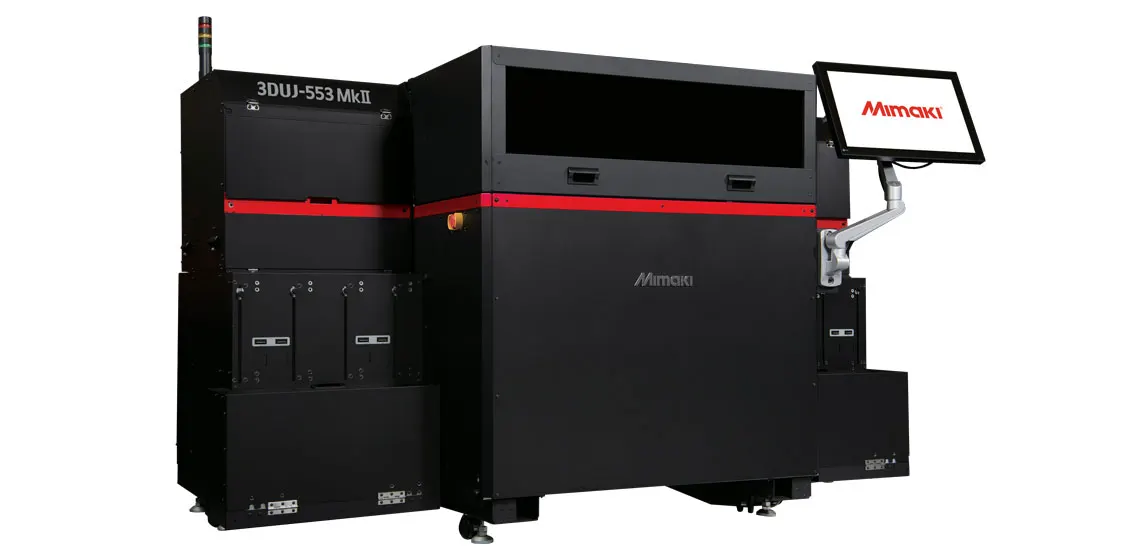
Image: Mimaki Europe

Mimaki Europe has unveiled the 3DUJ-553MkII full-colour 3D printer at Formnext 2026 in Frankfurt. The second-generation machine widens the colour range by roughly 1.4 times, reproduces material looks such as wood, leather and carbon fibre, and uses a separate low-cost material for the inside of objects. A new Smart Relay function starts queued jobs automatically.

Key facts
  • Colour gamut about 1.4 times larger than the 3DUJ-553, per Mimaki's own conditions
  • New cheaper infill material for the object interior
  • Smart Relay starts queued jobs automatically on the build platform
  • World premiere at Formnext 2026, Hall 2.1, Booth F129

Context Colour gamut is the range of colours a printer can reproduce; a larger gamut means more vivid and more accurate shades.

What is new on the 3DUJ-553MkII?

Compared with the earlier 3DUJ-553, Mimaki quotes a colour gamut about 1.4 times larger, measured under conditions the company defines itself. The aim is more accurate vivid colours, subtle shades and complex patterns. The printer can also mimic the look of wood grain, leather and carbon fibre, which suits mock-ups, concept models, figurines, collectibles and decorative pieces.

How does the new infill lower cost?

The previous model built the whole object from one material. The MkII uses a newly developed, cheaper material for the interior, while the outer surface keeps full-colour reproduction. Mimaki says the saving grows with object size, because larger parts contain more interior volume. It positions this for figurines, concept models and architectural representations that use the large build area.

What does Smart Relay do?

Smart Relay lets an operator schedule a follow-up job in advance. It starts by itself when the running job ends and uses free room on the build platform. Mimaki says this cuts idle time and allows production outside normal working hours.

Which software supports it?

Earlier this year Mimaki introduced the cloud service 3D Print Prep Pro v2.0 (3DP3v2) for preparing 3D data. It adds lattice structures that give cushioning or softening effects depending on the material, aimed at mock-ups of footwear, sofas and mattresses. The printer was shown at Formnext in Hall 2.1, Booth F129, from 17 to 20 November.

What it means

For model shops, design studios and prototyping bureaus, the case rests on cost per model rather than technology. A cheaper interior material and unattended job chaining act directly on material spend and machine utilisation. The savings figures are not published, so buyers should request a worked cost per part for their own typical sizes. This is a visual-prototype tool, so qualification and certification are largely irrelevant, but colour workflow skills in data preparation matter.

Frequently asked questions

What is the main cost change in the 3DUJ-553MkII?

It uses a dedicated, lower-cost material for the interior of printed objects while keeping full-colour material on the outside. Mimaki says the benefit rises with object size.

What does Smart Relay do?

It lets operators schedule the next print job in advance so it starts automatically when the current one finishes, using free space on the build platform.

Where was the printer shown?

At Formnext 2026 in Frankfurt, Hall 2.1, Booth F129, from 17 to 20 November.

Read the original reports
  1. Mimaki Europe, 17 Nov 2026
  2. TCT Magazine, 19 Nov 2026