AddiWire

Additive manufacturing news and European prices, with independent expert commentary

Industrial AM

Formnext 2026: large-format printers aim at lower cost and more robotic reach

Published 1 sourceSummary written with AIDeutsche Version
Formnext 2026: large-format printers aim at lower cost and more robotic reach
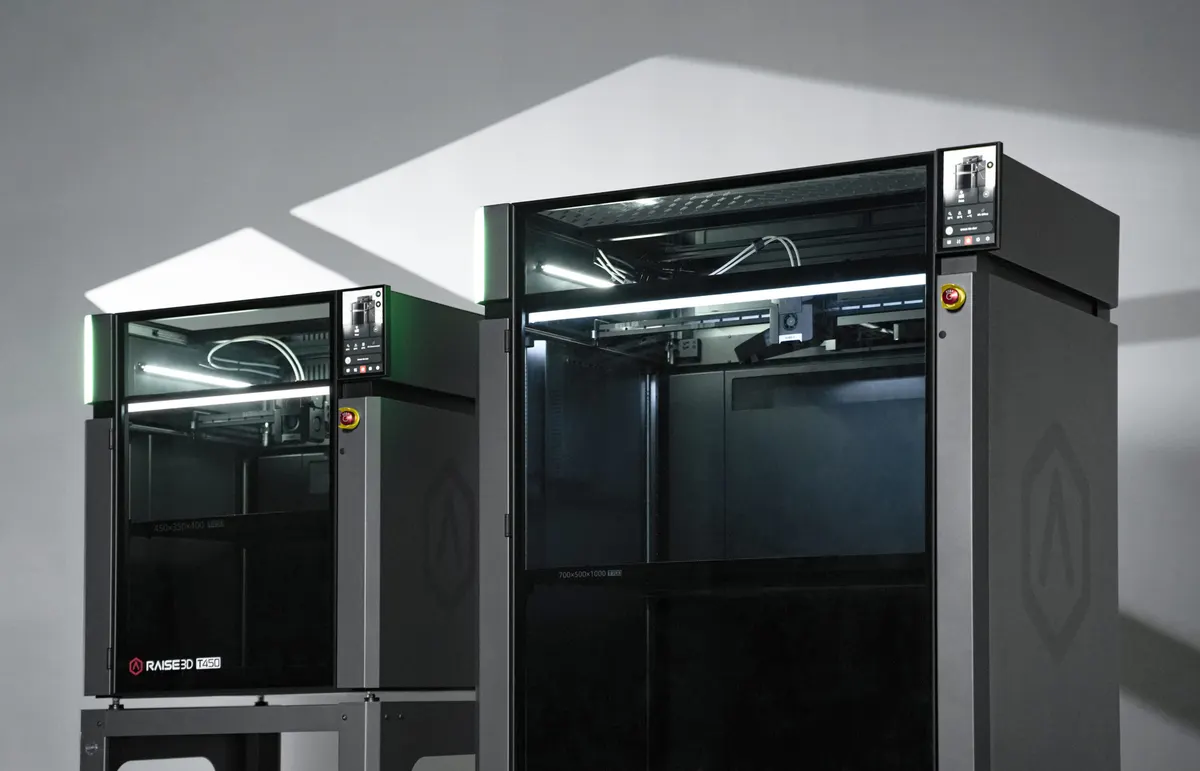
Image: Raise3D

At Formnext 2026 in Frankfurt, Raise3D, CMS, AltForm, WASP, BigRep and Farsoon are showing larger or more automated systems. The common thread is bringing big parts and tooling into regular production at lower cost, through cheaper entry machines, pellet feedstock, multi-robot cells and automated metal build handling.

Key facts
  • Raise3D T450 from $4,999 and T700 from $15,999; T700 prints parts up to one meter tall
  • Raise3D RMS220 SLS build height rises from 350 to 450 mm via update
  • AltForm ZENIT Modular spans 2 × 2 m with one robot to 4 × 4 m with four
  • BigRep PELLEX 750 offers 750 liters of build volume and runs pellets

Context Directed energy deposition (DED) feeds metal powder or wire into a focused energy source to build or add material onto a part, typically on large work areas.

What did Raise3D and CMS show?

Raise3D introduced the T450 from $4,999 and the T700 from $15,999, aimed at tooling and larger functional parts. The T700 prints up to one meter tall, which can avoid splitting a design into bonded segments. Raise3D cites battery cell transport trays that dropped from 40 to 10 days of production time and from 8 kg to 2 kg. The T450 is due to ship in late December 2026, the T700 in January 2027. A free update also lifts the RMS220 SLS printer from 350 to 450 mm build height, which Raise3D says could raise small-batch throughput by 25 to 30 percent.

CMS presented Krearob, a robot arm that prints large thermoplastic parts, molds and tooling from varying angles, with claimed material and weight savings of up to 80 percent depending on the application. It also showed the Kreator A3, a gantry style machine handling up to 30 kg of material per hour.

Which robotic and pellet systems were launched?

AltForm, formerly Prima Additive, launched ZENIT Modular, directed energy deposition cells in three sizes from 2 × 2 m with one robot to 4 × 4 m with four robots that can share one part or build four. Powder or wire can be used, including titanium and aluminum alloys, and the cells can be extended after purchase. The first units have been sold to aerospace and defense customers.

WASP updated its CUBO HDP Industrial pellet printer with a vacuum build plate and better heating, and added a lightweight pellet extruder for collaborative robots, a head-swapping system, a recycled-plastic process and an improved ceramic feeder. BigRep, with Massive Dimension, showed the PELLEX 750 on its ONE platform: 750 liters, about 4 kg of pellets per hour, third-party materials accepted. A wind turbine mold made from carbon-fiber-reinforced material served as the demonstration part.

What is new in metal?

Farsoon introduced the FS4X, a 99-liter metal powder bed system with up to six 1,000 W or four 2,000 W lasers. It is designed to work with automation that removes finished builds for cooling so the next job starts sooner, and with features meant to keep conditions stable and cut maintenance stops. At the show it is presented by video, with the machine itself at its European Innovation Center.

What it means

For small and mid sized manufacturers, the notable shift is cost at the entry end: machines from about $5,000 to $16,000 make in-house tooling plausible, though the Raise3D figures come from the vendor and cover a single use case. Pellet feedstock and modular robot cells shift the business case toward material cost and utilization rather than machine price. Qualification is not addressed in any announcement, so parts beyond tooling and fixtures still need a separate validation plan. Several machines ship only from late 2026 or 2027.

Earlier on AddiWire

Frequently asked questions

How much do the new Raise3D T Series printers cost?

The T450 starts at $4,999 and the T700 at $15,999. The T450 is expected to ship in late December 2026 and the T700 in January 2027.

What is the ZENIT Modular from AltForm?

It is a family of robotic directed energy deposition cells, from a 2 × 2 m area with one robot to 4 × 4 m with four. They print metal from powder or wire and can be expanded after purchase.

How does the Farsoon FS4X aim to raise output?

It works with automated systems that take finished builds out for cooling, so the printer can begin the next job sooner. It can carry up to six 1,000 W lasers or four 2,000 W lasers.

Read the original reports
  1. 3DPrint.com, 19 Nov 2026