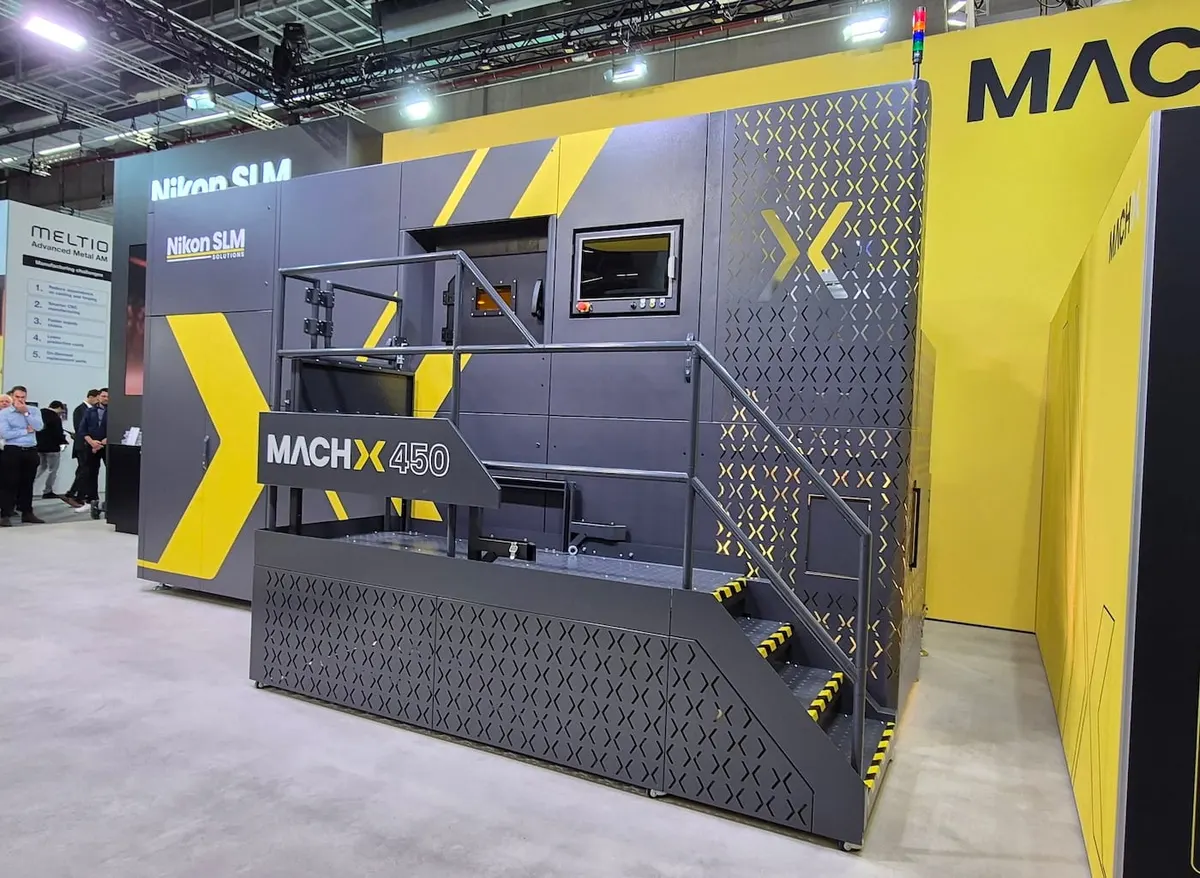
Metal systems: scalable printers and a larger depowdering station
Nikon SLM Solutions showed MACHX, a metal printer offered in three build envelope sizes so a customer can begin with one unit and add more. The largest version gives about 200 litres of build volume on roughly 13 m². Connections for automated material handling and shared depowdering let several machines operate as one cell, and an optional cylinder exchange preheats the next cylinder outside the chamber to shorten changeovers. German engineering firm GERG GmbH has already ordered several units.
Solukon presented the SFM-AT850 depowdering system for complex metal parts. It takes parts up to 1,000 kg and 650 × 650 × 800 mm, with a smaller overall footprint than the SFM-AT800-S. It is positioned alongside large-format printers such as the EOS M 4 ONYX and the Nikon SLM Solutions NXG XII 600.
Polymer systems: bigger chambers and lower cost per part
EOS introduced HELIOR, its largest polymer system so far, with a 700 × 380 × 580 mm build volume and three 70 W lasers. It targets high-volume producers and was developed with input from FKM Additive Manufacturing, Prototal Group, Materialise, Shapeways and Formrise. EOS promises up to 80% more throughput, quoting 154 litres in a 24-hour build at 10% packing density, and up to 80% less post-processing effort.
Stratasys launched the H550 for its SAF process, with a 34.2-litre build space and a length of 450 mm. The company says total cost of ownership falls by up to 30% against comparable print-and-fuse systems, with faster time to part than comparable SLS machines. 3D Systems added the MJP 300 multijet printer with a 294 × 211 × 144 mm build volume that can be split into three lanes, so small or tall parts are grouped for speed.
Automation and robotic cells
ATLIX, rebranded after the TRUMPF acquisition in September, showed an xBUILD 3000 inside a transparent cell built with DHR Engineering. A robot handles loading and unloading of build cylinders, swaps supply cylinders, moves recovery containers and refills powder, and ATLIX claims up to 98% machine utilisation. The company describes it as a starting point for discussion, not a finished product, and it recently announced a multi-machine xBUILD 5000 sale to BMW.
AltForm, formerly Prima Additive, premiered the ZENIT Modular Cell for directed energy deposition. It comes in three layouts from 2 × 2 m to 4 × 4 m, with up to four robots on one job, an inert chamber option for titanium and aluminium alloys, and expansion by adding modules.
Ceramics and desktop colour
Admatec, restarted after its closure by co-founder Michiel de Bruijcker and Formatec, showed the compact Admaflex Discovery at $92,500, aimed at universities and newcomers to ceramic printing. 3DCERAM launched the desktop CLP50, a top-down DLP system with a 96 × 54 × 100 mm build volume, 50 µm lateral resolution and open material parameters. Inkera presented its first product, the C1, a desktop full-colour UV material jetting printer with a 200 × 150 × 120 mm build area and eight material channels.