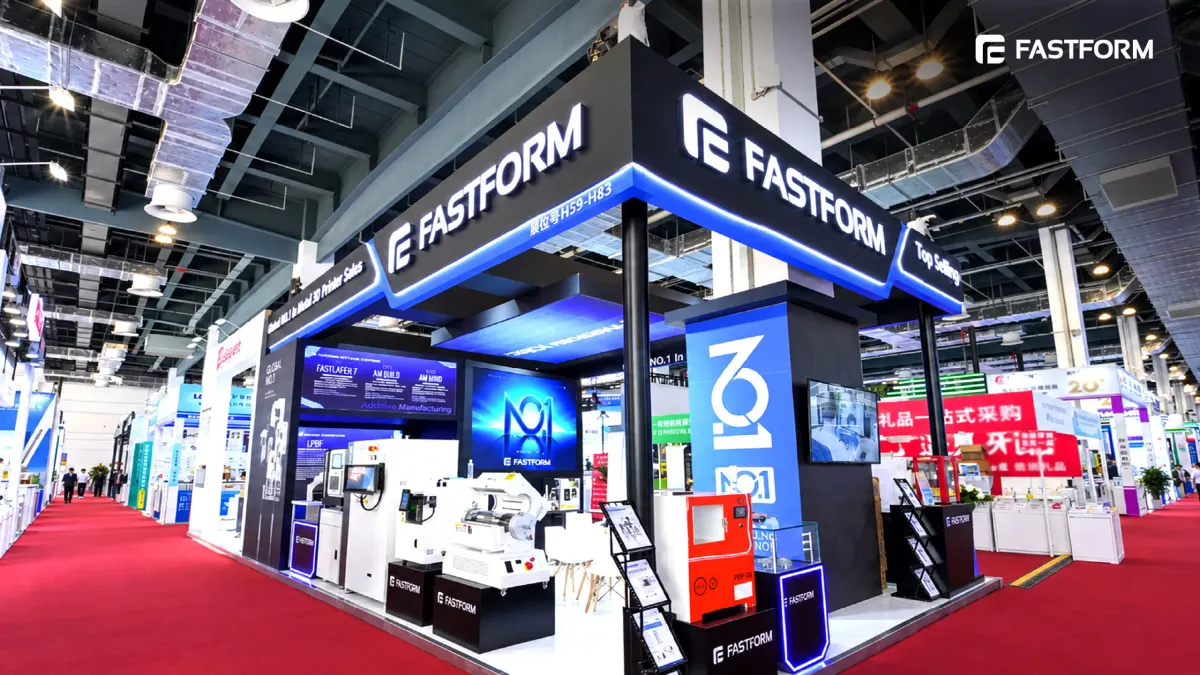
FastForm presented FastLayer 7 at DenTech China 2026 in Shanghai, AI software that prepares a full build plate of dental metal frameworks automatically. In the company's own demonstration, 30 frameworks were oriented, nested and supported in about three minutes, against one to two hours by hand. The vendor stresses that the result applies to a defined test scenario.
Key facts
Shown at DenTech China 2026, Shanghai, opened 22 October
30 dental frameworks prepared in about three minutes on FF-M220
Manual preparation stated at one to two hours
Available on DeskFab X1, FF-M140 and FF-M220
Context Nesting means arranging many parts on the build plate to use space well, and supports are the thin structures that anchor a part during metal printing.
What does FastLayer 7 automate?
The software takes over four steps of build preparation: analysing the model to pick an orientation, generating connector bars by preset process rules while avoiding collisions, nesting frameworks across the whole plate, and creating supports from model features. In the demonstration on the FF-M220, a fully loaded plate of 30 dental frameworks was ready in about three minutes. FastForm states manual preparation takes one to two hours and speaks of up to 40 times higher efficiency.
Why does it matter for dental labs?
Manual preparation depends on experienced technicians, results differ between operators, and printers can sit idle while files wait in a queue. FastForm argues that automation makes the step repeatable and that new operators can handle it after standard training, freeing experts for process quality and exceptions.
How is it tied to the hardware?
FastLayer 7 connects to FastForm's process database and equipment software, and the company positions this as an alternative to third-party tools with licence fees and compatibility gaps. It is available across the dental portfolio: DeskFab X1, FF-M140 and FF-M220. FastForm reports more than 3,000 systems installed worldwide in dental and industrial use.
What it means
For dental labs, build preparation is a real labour bottleneck, so automating it could raise printer utilisation and reduce dependence on a few experts. The figures come from the vendor's own test with standard models, so labs should check them against their own case mix, including tight or unusual frameworks. Software bundled with one manufacturer's printers also means tighter lock-in, which belongs in the cost comparison. Qualified operators and documented process rules remain necessary even when preparation is automatic.
Frequently asked questions
How fast is FastLayer 7 according to FastForm?
In a demonstration on the FF-M220, it prepared 30 dental frameworks in about three minutes, against one to two hours manually. FastForm describes this as up to 40 times more efficient.
Which printers support FastLayer 7?
It is available across FastForm's main dental metal portfolio: DeskFab X1, FF-M140 and FF-M220.
Do the results apply to every lab?
No. FastForm states the figures come from a defined test with standard models, and real results can differ.