AddiWire

Additive manufacturing news, prices in the EU and the USA, and independent expert commentary

Software

Eplus3D adds Oqton 3DXpert as standard software option for its metal printers

Published 1 sourceSummary written with AIDeutsche Version
Eplus3D adds Oqton 3DXpert as standard software option for its metal printers
Image: OQTON 3DXPERT

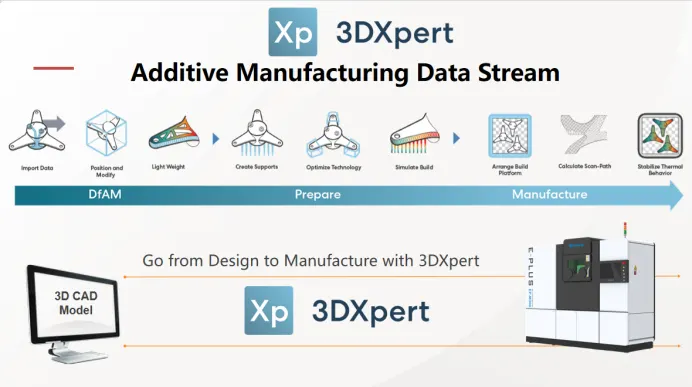
Eplus3D and Oqton are working to make the 3DXpert build preparation software run more closely with Eplus3D laser powder bed fusion systems. 3DXpert is now one of the standard software options for Eplus3D machines. A first proof is an Inconel 718 fuel tank printed on the EP-M300 using Oqton's MeltControl scan strategy.

Key facts
  • 3DXpert is now a standard software option for Eplus3D systems
  • Demo part: Inconel 718 fuel tank printed on the EP-M300
  • Planned: direct EPI output and EPHATCH parameter conversion
  • Companies say not every function is commercially available yet

Context MeltControl is Oqton's simulation-driven scan path optimisation in 3DXpert: it adapts laser energy locally, for example under low overhangs, instead of using one fixed parameter set for the whole part.

What MeltControl does on difficult geometries

In laser powder bed fusion, low-overhang surfaces often need supports to stabilise the build and manage heat. These supports add material use and post-processing, especially inside enclosed or hard-to-reach features. MeltControl, part of 3DXpert, adapts scan vectors using simulation. It considers down-facing angles, nearby heat-sinking material and local thermal conditions, and adjusts the energy input where needed. According to the companies, this can reduce reliance on conventional supports, though the gain depends on the application and process.

Inconel 718 fuel tank on the EP-M300

To show the approach, the two companies printed a complex Inconel 718 fuel tank on the Eplus3D EP-M300. Its curved profile and low-overhang regions served as a test for localised scan strategy. Eplus3D supplied the platform and technical support, Oqton the software and process expertise. The companies see similar strategies as relevant for other aerospace and propulsion parts such as volutes, turbopump components and complex flow passages.

Planned workflow integration

The collaboration covers four integration areas: Eplus3D slicer capabilities inside 3DXpert, a direct route to generate EPI files for Eplus3D systems, conversion of existing EPHATCH process parameters into the EPI-based workflow, and closer use of optimised scan strategies in the Eplus3D toolpath. The companies state that these are development directions, not a claim that every function is already commercially available. The intended benefits are fewer manual data transfers and continuity for existing parameters.

What it means

For manufacturers, the practical value lies in the workflow, not the single demo part. Open software options on a machine can lower dependence on one vendor's toolchain and preserve existing process parameters, which matters for qualification effort. Reduced supports could cut post-processing cost, but the companies themselves say the gain is application-dependent, and several integrations are still in development. Buyers should ask which functions are validated and available today, and verify support savings on their own parts before planning around them.

Frequently asked questions

What is MeltControl?

MeltControl is a function in Oqton's 3DXpert that adapts laser scan paths locally using simulation, considering down-facing angles, nearby heat-sinking material and local thermal conditions.

Is the full integration already available?

Not entirely. 3DXpert is offered as a standard software option for Eplus3D systems, but the companies describe slicer integration, direct EPI output and EPHATCH conversion as development directions.

What was printed to demonstrate it?

A complex Inconel 718 fuel tank on the Eplus3D EP-M300, with curved geometry and low-overhang regions.

Read the original reports
  1. OQTON 3DXPERT, 17 Nov 2026