What is the Swaptek system?
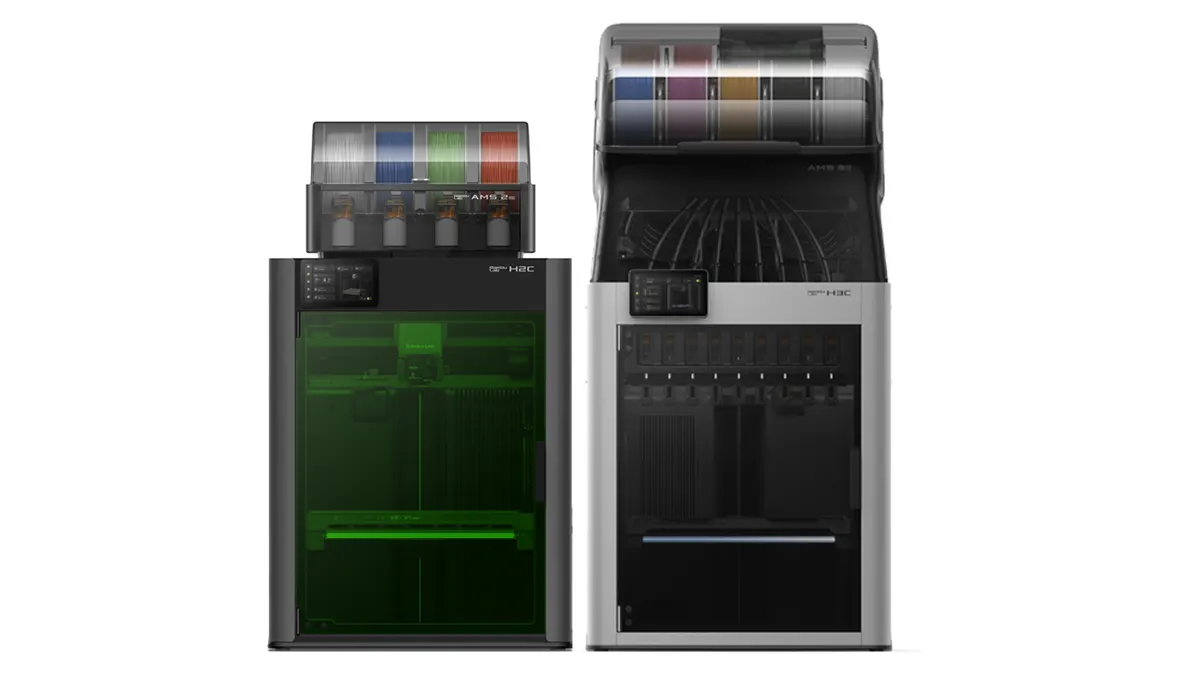
The H3C carries nine tools, each with a built-in nozzle, heater, hardened steel tip (HRC 55+) and a dedicated filament path. Nozzles stay loaded and preheated, and Tom's Hardware measured about six seconds between colours. The tools dock on a front rack that retracts so the first layer stays visible. Each nozzle is held by three screws and can be swapped for other sizes.
The machine ships with eight 0.4 mm tools for 1.75 mm filament and one for 2.85 mm filament. A standard 1.75 mm tool costs $59 extra. Cutting, drawing, embossing and foil transfer tools are announced but were not available at review time. There is no laser variant.
How are filament, drying and TPU handled?
The AMS 3H module is required and sits on top of the printer, making the unit over a metre tall. It holds nine spools, seven slots have a TPU bypass, and two slots sit in a sealed chamber that dries up to 85 degrees C, even during printing. Up to four further AMS units can be attached through an optional buffer, but these run through the fifth tool slot and lose the purge-free benefit.
The FlexFeed extruder adapts between 1.75 mm and 2.85 mm filament. Bambu supplied a 75A TPU, aimed at footwear. The reviewer reported pre-launch issues on beta firmware, including a clicking stepper and a tool that could catch on tubes and dismount during long multicolour prints.
What changes for existing printers?
Bambu is adding multi-orifice nozzle printing, meaning different nozzle sizes on one part, to its dual-nozzle models. Without a filament track switch the update is planned for November 2026 on the H2D and February 2027 on the H2C and X2D. With a track switch the dates are February 2027 for the H2D and March 2027 for the others. Bambu calls it a low-level adaptation of slicing logic and print parameters.